 GSP
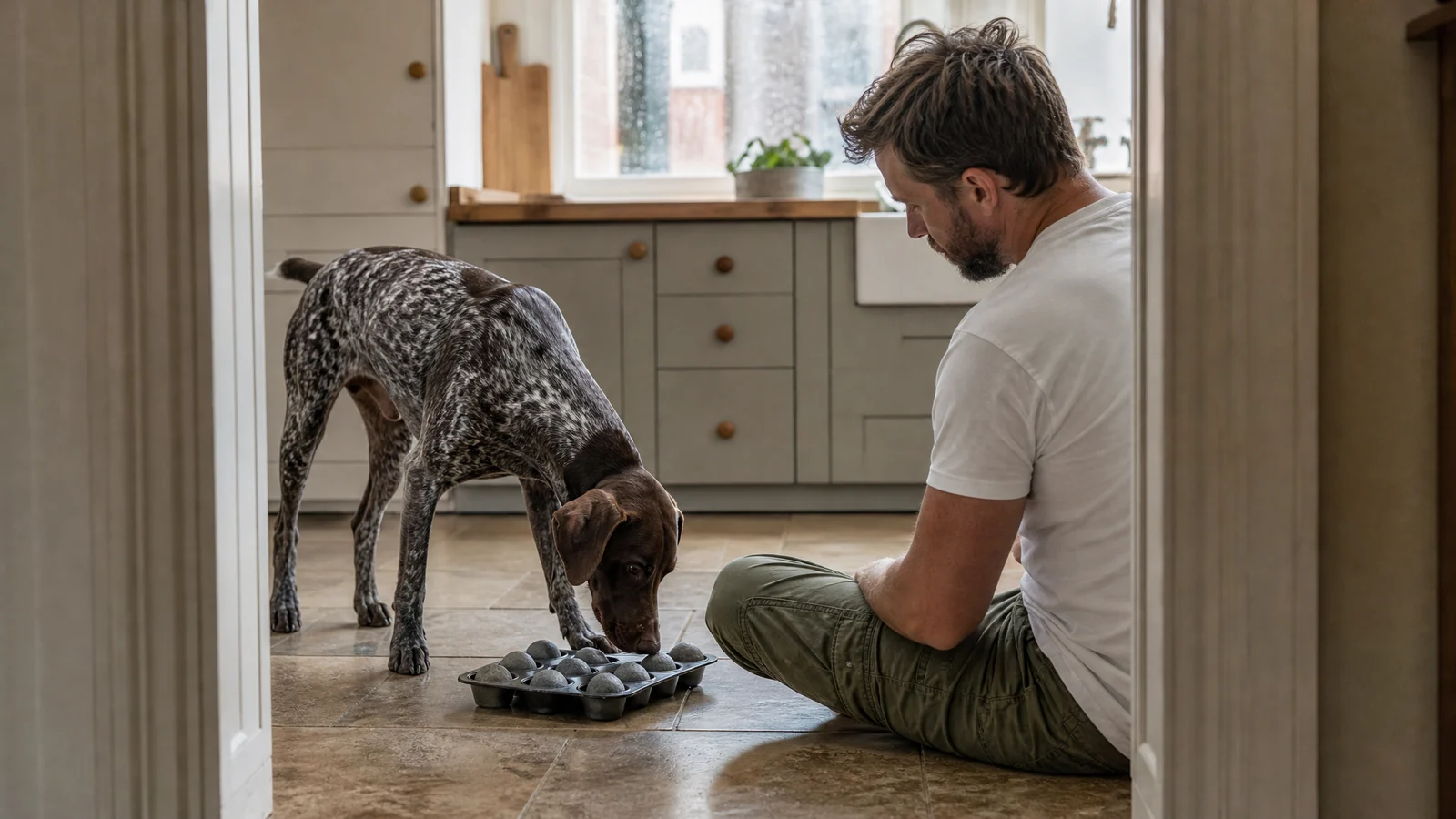
Nails clicking between the kitchen and the back door, a head pushed under your hand, a sock that has quietly gone missing: a German Shorthaired Pointer with nothing to think about has ways of telling you so. It is rarely bad behavior. It is a quick, capable dog looking for a job and taking whatever is closest.
Hand them a better job and the house gets quieter. Searching for hidden food and working a puzzle both count, and this is a breed that learns quickly with consistent sessions.
Read on for a find it game taught in three stages, puzzle dinners built from the recycling bin and a plan for fitting both around your walks. Every step starts easy enough for your GSP to win the first round.
German Shorthaired Pointer Brain Games Worth Playing Indoors
The better job in question is any brain game, and they all share one feature: your dog has to work something out before the reward arrives, whether that means following a smell, nudging a lid aside or waiting for a cue. For this breed that is more than entertainment, because a GSP needs a purpose, and one without it can turn destructive when left to invent their own.
We keep the indoor menu short: a nose game for any day your GSP needs more to do, a food puzzle that turns dinner into a job and a one-minute refresher of a cue your dog already knows. The nose game goes first, since it needs only treats and a clear patch of floor, and the word it teaches gets reused whenever you hide something.
Teaching the Find It Cue to a German Shorthaired Pointer
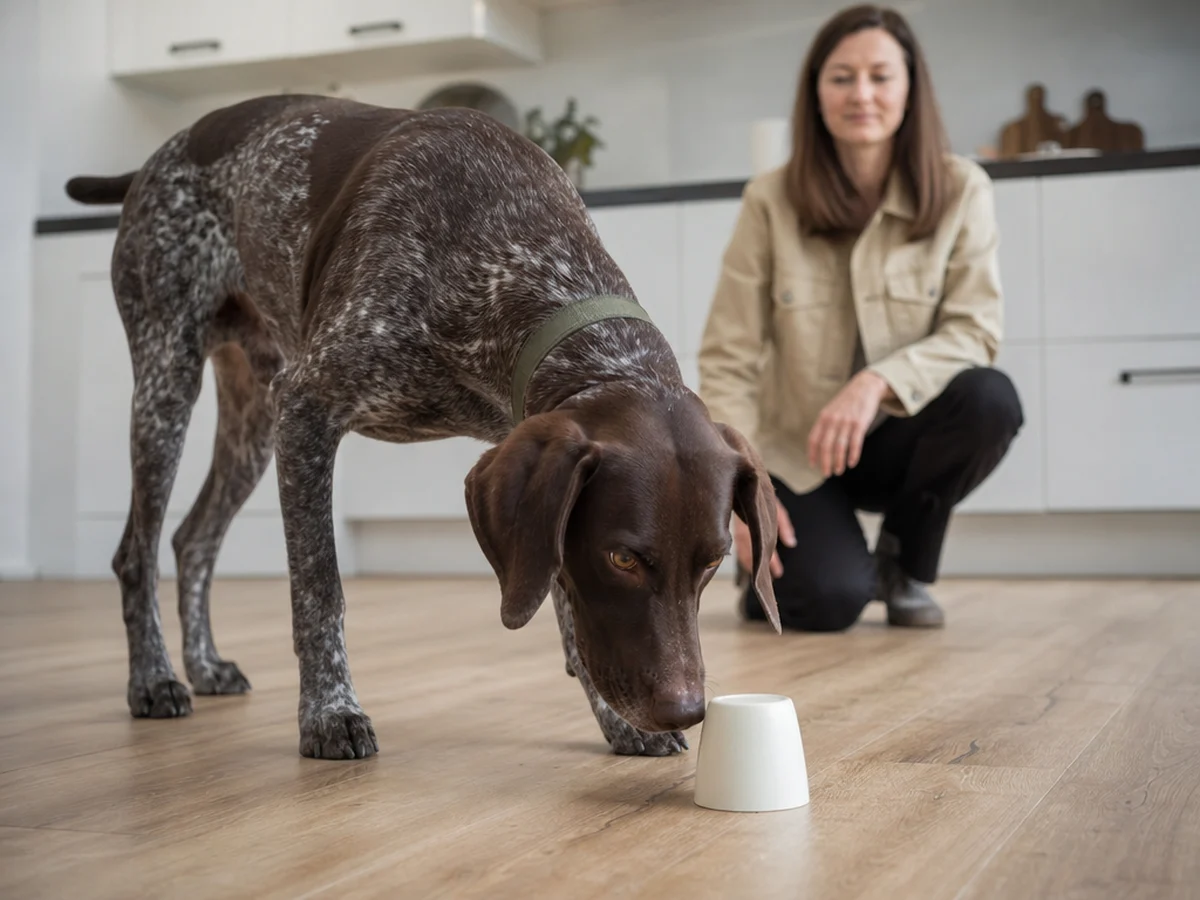
Since the nose game goes first, here is the whole climb in order, with a signal for moving on and a fix for a stall at each stage. Use a treat your GSP finds exciting, because the smell is what carries the lesson.
Stage One Starts With a Treat in Plain Sight
Begin with the easiest version, where your GSP can watch the treat land. That teaches the one idea every later stage depends on, which is that the floor is where the reward lives.
Run every round the same way, with the same word and the same kind of treat, so the game is easy for your GSP to read and each stage can build on the one before it:
- Ask your GSP to wait beside you, or have a helper hold their harness, while you show them a smelly treat.
- Set the treat on a bare patch of floor a few steps away, in plain view.
- Say "find it" in a bright, easy voice as you let go, so the word becomes the signal to start.
- Let your dog eat the treat when they reach it, then bring them back and set the next one a little farther off.
Move on when your GSP trots straight to the floor on the cue several rounds in a row. If they look at you instead of the treat, set it closer or switch to a smellier one, so the floor pays better than your face does.
Stage Two Tucks the Treat Out of Sight
Now the nose has to do more than the eyes, and the way there is gradual. Put the treat behind a table leg, then under the edge of a folded towel, then around the corner of a doorway, changing only one thing between rounds. The MSPCA-Angell sniffer game builds the same way, gradually making the search harder by putting treats under something or around a corner.
Whenever your GSP stalls, go back one hide and let them win a round before you try again. A search that ends in a found treat teaches more than one that drags on.
Stage Three Adds a Row of Boxes
Boxes turn one hide into a question about the whole room. Set out several open cardboard boxes on the floor and put a smelly treat in some of them while your GSP waits in another room, then bring them in and say "find it."
The idea in Best Friends' beginner box search is to encourage the dog to self-reward, so leave the boxes open and easy to reach at first. Each round only needs to last a minute or two, with the complete session lasting about 15 minutes, and the next challenge could be loosely closing the boxes, putting them above floor level or nesting boxes inside boxes.
Add one challenge at a time, and drop back to open boxes on the floor if your dog loses interest. Once the cue has been paid on food at every stage, it works with a favorite toy hidden in the same boxes, which gives a dog who is less food-driven a reason to search too.
Muffin Tins, Boxes and Other Puzzle Dinners
Once find it is running, the same treats can leave your hand altogether and live inside a puzzle. The Wisconsin Humane Society suggests starting with an easy option and building up to more challenging toys over time, and says you may need to help your dog figure out what to do at first. That pace suits household puzzles too, and any tape or plastic labels should come off cardboard boxes before your dog gets near them.
Three household puzzles cover most evenings, and the list runs from easiest to hardest so you can start at the top and work down as your GSP gets the idea and the tin stops being a mystery:
- Muffin tin: put kibble or a treat in several cups and set a tennis ball or other toy on top of each, so your GSP has to sniff out which cups hold food and nudge the toys aside.
- Paper roll. Fold one end of a paper towel roll shut, drop in a few treats and fold the other end, then let your dog work it open on a rug instead of the couch.
- Nested boxes raise the stakes: seal a smelly treat in the smallest box and tuck it inside a bigger one, so the search becomes a small excavation.
Stay in the room for every puzzle, and skip the box versions altogether if your GSP swallows cardboard instead of tearing it. If a puzzle turns into a chewing session, our guide to chew toys for a GSP covers what to leave out for that.
Fitting Indoor Games Between Walks
With three kinds of games in hand, the next question is where they belong in a day that already holds walks. They belong beside outdoor time, not instead of it: a few minutes of find it while dinner cooks, a muffin tin on a quiet evening and a quick refresher of a cue your dog knows all add thinking to a day that still needs real movement. A nose-down sniff walk adds the outdoor version of the same nose work.
If your dog seems slower, stiffer or less keen than usual, treat that as a question for your vet rather than a training problem, and keep up regular vet visits so changes get noticed early. A sore or older GSP may still enjoy a treat on the floor, but what suits their body is a vet's call.
Practical Indoor Game Questions
Between a first muffin tin and a busy household, most changes to a game come down to the food, your absence and who else is home. These answers cover one of each.
Can Dinner Stand In for Treats?
Yes, for most games. Kibble from your GSP's regular meal works in a find-it round or a muffin tin as long as it smells interesting enough to earn the effort. If your dog walks past it, swap in a smellier treat for the game and save the kibble for the bowl.
Can I Leave a Puzzle When I Go Out?
Not until you have watched your GSP solve it calmly several times with you in the room. Even then, choose something too large to swallow in pieces, and skip cardboard entirely if your dog tends to gulp it down. When you are unsure whether an item is safe to leave, ask your vet.
Can Children Help Hide the Treats?
Yes, and it makes the game a family one. Let a child set a treat in an open box while an adult holds your GSP's harness, then call the dog in together so the child stays beside the box. Keep rounds short, and teach children to let the dog eat what they find instead of reaching in.
Watching a German Shorthaired Pointer Work the Room
Once those details are sorted, the game mostly pays you back in what you get to watch. A GSP who has spent the day running on instinct will stop in the middle of the room, sweep one corner, change their mind and commit to a box, and every step of it is your dog working something out.
Watching also gives the next game away: whichever hide made your GSP pause and think is the one worth bringing back tomorrow. A mind this quick has more to learn than find it, which is why signing up on this site brings our complimentary e-book to your inbox, covering everything else your GSP has to be taught in sections brief enough to finish in one sitting.
 Training basicsAre German Shorthaired Pointers Easy to Train? Smart or Stubborn
 Training basicsAre German Shorthaired Pointers Good With Kids?
 Training basicsHow to Choose a German Shorthaired Pointer Trainer
