 GSP

A German Shorthaired Pointer puppy comes home with a big reputation, and that makes it easy to wonder how much you are supposed to teach in the first month. The honest answer is less than you might expect. Between eight and twelve weeks, the useful work is small and social. Your puppy needs to find out that you are worth watching, that settling down is something they can choose to do, and that new sights and sounds come with good news.
Sit, down and stay can wait for their own guides, and they will go faster because of what you build now. This guide covers what is shifting in your puppy this month, the three small habits worth starting, and how to bring in the wider world without overloading a young GSP.
A Puppy Whose Attention Is Turning Toward People
Those three habits make more sense once you know what your puppy's mind is doing at this age. Four points are worth keeping in mind.
- Puppies tend to shift their focus to people somewhere between 5 to 12 weeks of age, after an earlier stretch of looking mostly to other dogs.
- They stay most receptive to learning how to handle new situations until about 16 to 20 weeks.
- That is a general pattern for puppies of every breed, so use it as a frame and let your own puppy set the speed.
- Individual puppies run ahead or behind on any calendar, and a puppy who is wary of something new at ten weeks is not off track, because many puppies pass through a cautious stretch around now. Where this window sits in the longer road is mapped in our GSP puppy timeline.
German Shorthaired Pointers arrive friendly, smart and eager to work alongside people, so when your puppy's attention turns toward you, there is plenty of enthusiasm waiting to be directed. As GSP people, we put the first job right there: be the most rewarding thing in the room before you ask for anything else. A puppy who checks in with you now is far easier to teach everything that comes later.
Paying a German Shorthaired Pointer Puppy for Attention
If your puppy's attention is turning your way, the first habit is simply paying for it, and the name game below is the easiest way to start. Work through the steps in order, and stay on each one until your puppy does it smoothly several times in a row.
- Pick the pay. Find out what your puppy works hardest for, whether that is a few pieces of their breakfast kibble, a softer treat, a favorite toy or a cheerful "good puppy". A puppy who is only mildly interested in the reward will only be mildly interested in you.
- Say the name once: Wait for a moment when your puppy is not busy, say their name in a bright voice and then stay quiet. The instant they turn toward you, say "yes" and hand over a treat. Repeating the name teaches your puppy that the first one can be ignored.
- Pay Close to You: Deliver the treat at your knee or hip, not out in front of you. Your puppy then finishes every repeat looking at the spot where you stand, which is exactly the habit you are building.
- Take the game to another room once your puppy responds smoothly in the first one, and later to the yard on a quiet day. A response that works only in the kitchen is a kitchen trick.
After a few days you should see your puppy swivel toward you at the sound of their name, even in the middle of a sniff. Keep the name for good news, since a name that sometimes signals a bath or a closed gate soon stops working. If your puppy does not turn, do not repeat it. Move closer, cut the distractions and try again.
A Mat Lesson for a Puppy With Boundless Energy
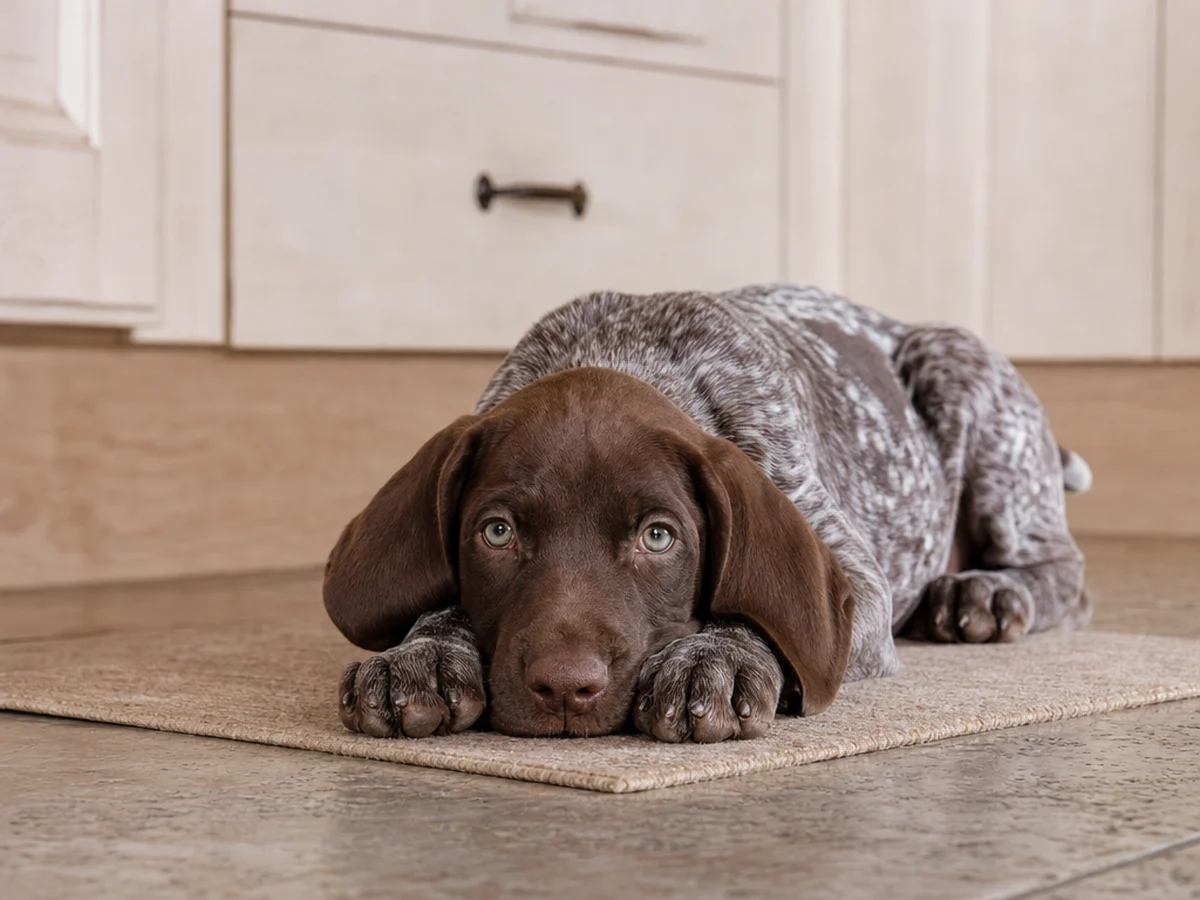
Attention is only half of what a keen puppy needs from you, because the other half is learning how to stop. A German Shorthaired Pointer has very high energy and needs something to do, and a puppy who never learns to wind down will invent their own jobs, usually with your shoes.
Start with a blanket or small mat in a quiet corner of the room where you spend your evenings. Let your puppy explore it, and each time a paw or the whole puppy lands on it, say "yes" and hand over a treat. When they begin to lie down on it, wait a little longer between treats, then offer a GSP chew toy stuffed with something tasty so the mat becomes the place where calm, good things happen. End the session before your puppy wanders off on their own.
In our experience, the first week is mostly circling and mat-stomping, and that is fine. If your puppy treats the blanket as a launch pad, shrink the game by paying for one paw, then two, and let the chew toy do the work of keeping them there. Mat time also settles faster right after play, because a puppy whose needs for activity are met is ready to rest, so fit it in beside the walks, play and rest that suit a growing GSP.
New Sights at a German Shorthaired Pointer Puppy's Pace
A puppy who can pay attention and settle on a mat is ready for the part most owners worry about, the wider world. The temptation is to pack in as many new experiences as possible, but quality matters more than quantity, and a frightening meeting teaches a puppy the wrong lesson. Splitting the world into separate projects keeps each one small enough to succeed.
These are the projects that suit the weeks before twelve, and each one is practiced on its own so that nothing arrives all at once and a single surprise cannot undo the rest.
- A sound at a time, such as the doorbell or a dropped lid, started quietly or from far away while your puppy eats a few treats, and stopped when the treats stop.
- Surfaces and objects, from a tile floor to an umbrella, left where your puppy can sniff them at their own pace while treats land nearby.
- People one at a time, with each visitor sitting down and letting your puppy come to them instead of reaching in.
- Gentle handling of a paw or an ear, paired with a treat so that hands become good news.
Between projects, read your puppy before moving on. Loose, wiggly body language means you can carry on, but a puppy who backs away or turns down food is telling you the step was too big, so add distance and let them recover.
Keeping Vet Visits in the Plan
Your veterinarian can advise on socialization and on which outings suit your puppy right now, so keep regular vet visits on the calendar and treat each one as a practice run in a new place, with treats in your pocket. Our guide to socializing a German Shorthaired Pointer goes further on children, dogs and strangers.
Puppy Doubts Before the Twelve-Week Mark
Most of the doubt in this month sits around outings and nerves. Here is where we land on each.
Can my puppy meet a neighbor's dog yet?
Ask your vet first, because they know where your puppy stands on shots. Until they say otherwise, keep your puppy off ground where unknown dogs walk, which rules out dog parks and pet stores. A short, calm visit to a friend or relative whose well-behaved dog is up to date on shots makes a safer first meeting.
What if my GSP puppy seems shy?
A wary moment does not cancel the breed's friendly streak, and plenty of puppies go through a cautious stretch at this age. Never push your puppy toward whatever worries them. Stop where they can stay relaxed, toss a treat their way for looking at it and let them decide whether to come closer. If the wariness grows, or spreads to everyday things around the house, mention it at your next vet visit.
What if my puppy falls asleep on the mat?
Let them sleep. A puppy who drops off on the mat has just found the best part of it, and naps belong in a young puppy's day, so end the lesson there and give them some peace.
A Puppy Who Finds You Worth Watching
Everything on this page rests on one bet: a puppy whose attention is already drifting toward people will keep drifting your way if the trip pays well. Between eight and twelve weeks that drift comes free, and your only job is to be worth the glance.
A German Shorthaired Pointer will bring plenty of keenness to every stage that follows, and keenness goes wherever it gets paid. Point it at yourself while that is easy, and the leash walks, recall games and teenage months ahead start from a dog who already looks for you first.
Week twelve is where the first stage ends and a long education begins, and the e-book we send at no cost to new sign-ups on this page carries your GSP through what comes after, clearly and in depth.
 Puppy trainingGerman Shorthaired Pointer at 3 to 4 Months: Teething and Training
 Puppy trainingGerman Shorthaired Pointer Puppy at 4 to 6 Months: What Changes
 BehaviorTraining an Older or Adopted German Shorthaired Pointer
