 GSP
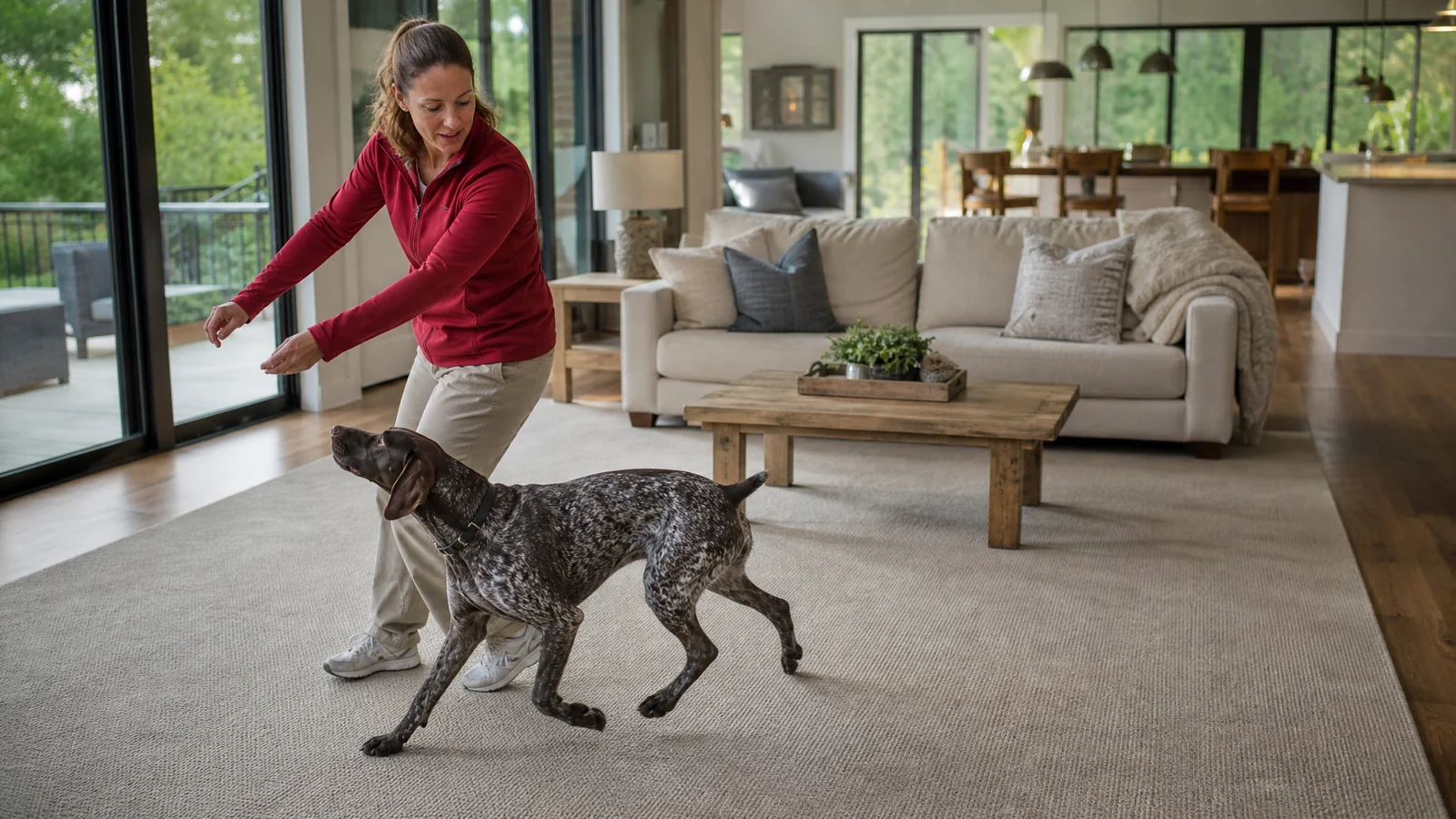
A spin is a friendly first trick for a German Shorthaired Pointer. It needs a treat, a bare patch of floor and a dog who is happy to follow your hand, and a bright, willing breed like this one often fits that last part well.
The part that takes care is the shape of the circle. A treat dragged around too fast gives you a head bob, a lunge or a dog who sits down halfway, so we teach the turn in three small stages and only then add a word and fade the treat out of your hand.
Below you'll find every stage with its steps and its move-on test, the fixes for the usual stalls, and three short answers on exercise, family cues and where to practice next.
The Finished Spin and What It Takes to Reach It
Before the first treat comes out, picture the finished trick: one full circle in a single direction, slow enough for your dog to stay balanced, ending with them facing you and waiting for their reward. A GSP is smart and learns quickly, so whatever shape of circle you pay for early is the one they will offer again, wobbles included.
Setup is simple and takes only a few things. Each piece has a job:
- Footing: a nonslip floor with a few feet of open space on every side, so your dog can turn without sliding or bumping into furniture.
- Pick treats that disappear fast. Tiny, soft pieces keep the circle flowing, because a dog who stops to chew loses the thread of the turn.
- Your marker word: a short word such as "yes," said the instant your dog completes a piece of the turn, with the treat following straight away.
- Choose one direction and stay with it for now, which keeps the first lesson simple for both of you.
Start in a quiet room, because a distraction-free environment keeps your dog's attention on your hand, and move outdoors once your dog has mastered the trick. A very high energy level means a GSP will find plenty to look at anyway, so let the room stay boring.
How to Teach a German Shorthaired Pointer to Spin in Stages
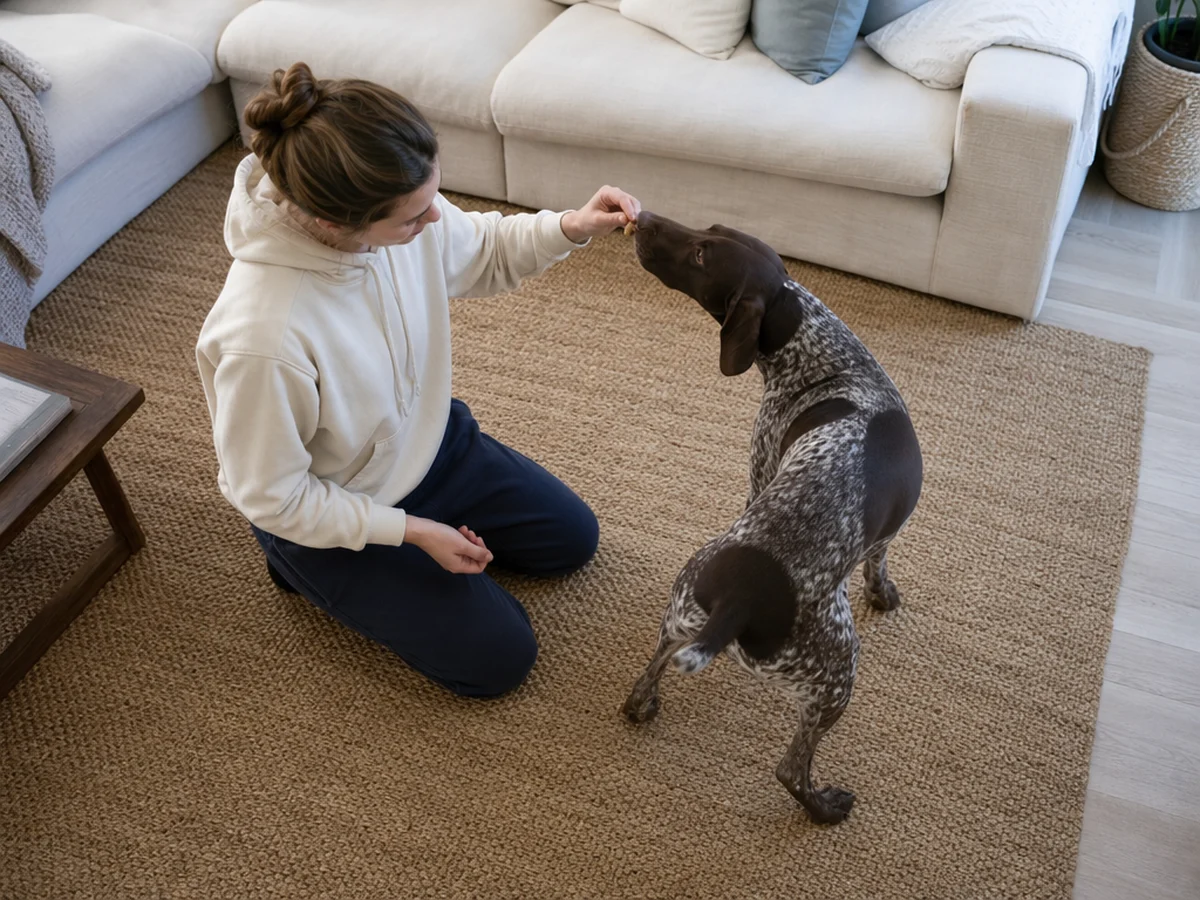
With the room ready, the circle gets built outward from the nose, one small piece at a time, because asking for a full loop on the first try is how you end up with the lunge and the head bob.
A Quarter Turn Toward the Treat
Start with a turn so small it barely counts as a spin. The steps are short:
- Hold a treat just above your dog's nose, close enough to follow and low enough that they do not need to jump for it.
- Slowly move the treat a few inches to one side so the head turns and the front feet shuffle after it.
- Say your marker word the instant the head turns toward your hand, then give the treat.
- Reset your hand and repeat until the turn is smooth.
Move on when your dog follows the treat into that small turn smoothly several times in a row. If they freeze, shrink the movement and bring the treat nearer their nose, and if they hop up for it, lower your hand.
Stretching It to a Half Circle
Now ask for a little more before you pay. Keep the treat moving slowly around until your dog has turned far enough to face away from you, then mark and reward at that point, not after they have drifted off. A keen GSP will want to race ahead of your hand, so move slowly enough that the nose never has to catch up.
When a miss happens, go back to the quarter turn for a couple of easy wins and then try the half circle again. Move on when the half circle looks smooth and relaxed several times in a row.
Closing the Full Circle
Keep drawing the same slow, wide circle until your dog has come all the way round to face you again, and mark and pay at that finish, not partway. Paying at the finish teaches the circle has an end, so your dog stops in front of you instead of chasing the treat in loops.
If they stall at the halfway mark, spend a few more turns paying for the half circle and stretch it only slightly each time. When the full turn comes without hesitation several times in a row, you have the trick, and what remains is putting a word on it.
Adding a German Shorthaired Pointer Spin Command
A full circle that comes easily means the treat has been doing all the talking, so now it is time to hand some of that job to a word and a hand signal. Both go in gradually, so your dog is never asked to guess.
Wait until your dog is consistently following the lure all the way around, then start adding the verbal cue just before your hand moves, with a word such as "spin," "twirl" or "around." Teach the other direction the same way, and once your dog is consistently following the cue both ways, use the circle hand motion without a treat in your hand while giving the cue, then praise and treat when they spin.
The word and the hand signal arrive one at a time. Put together, the fade looks like this:
- Say the cue word, then draw the circle with a treat in your hand exactly as before, and reward at the finish.
- Repeat until your dog starts to turn as soon as they hear the word, before your hand has gone far.
- Swap the treat for an empty hand drawing the same circle, say the cue, and reward from your other hand when the circle ends.
- Make the hand motion smaller a little at a time, until it is a small twirl of a finger.
Keep the treat in the hand that is not making the circle, because it is important to quickly move to giving the treat afterward so that your dog is not being bribed to start. That small change turns the treat from a lure into a payment, which is why the empty hand works at all.
When a GSP Spin Falls Apart
Even a well-built spin wobbles when the treat disappears or the room gets busier, and the cure is nearly always to go back one stage instead of pushing harder. Each fix below starts from what you are seeing.
The Circle Stops Halfway
Your dog follows the treat to the shoulder and then looks up at you. Slow your hand, bring it closer to the nose and pay for the half circle again for a few turns before stretching it. A stall like this tells you the last step was too big, so a smaller piece is the kind answer.
Your Dog Jumps or Sits Down
A dog who hops for the treat is telling you it is too high, so lower your hand to nose level. A dog who sits instead of turning has found a habit that has paid before, so mark the first head turn and keep the treat moving before they have time to sit. If jumping is already a habit at home, our German Shorthaired Pointer jumping guide covers it.
The Turn Gets Fast and Small
As the circle shrinks, an excited GSP can tighten it into a quick little whirl. Go back to a slow, wide hand and keep sessions short and enjoyable, so the energy stays useful. If your dog ever seems stiff or reluctant to turn one way, pause the trick and mention it at your regular vet visits.
A Few Practical Spin Questions
Once the circle is reliable, three practical points tend to matter most. They are how much the trick tires your dog, who gets to ask for it and where to practice next.
Does a spin count as exercise?
No, not in the way a GSP needs. A spin is a short burst of thinking, which suits a dog who does best with plenty to do, but it does not replace the walks, runs and play a very high energy dog needs. Our GSP sports and jobs guide has outlets for the rest.
Can everyone in the family give the cue?
Yes, as long as everyone uses the same word and the same hand motion, because your dog is learning that exact pairing. Agree on one word before you start, and let each person practice a few turns with the treat in their other hand.
Where should we practice next?
Move to a different room, keep the treat in your hand again for a few easy turns, and then fade it as before. Change one thing at a time, such as the room, then the helper, then the yard, so your dog can keep succeeding while the setting changes.
A Spin With a Favorite Side
Do not be surprised if your German Shorthaired Pointer turns more smoothly one way than the other. In our experience the second direction trails the first for a while, because the first had all your early practice and the second has had less.
That is fine. Ask for the polished direction when you want to show the trick off, and give the weaker side its own short, easy sessions, paying for the same quarter turn you started with. Neither side needs to be perfect to be worth having.
When you want this same step-by-step approach for the rest of your GSP's lessons, our e-book, emailed to readers who join the list, walks through each skill in plain language.
 Exercise and jobsHow to Teach a German Shorthaired Pointer to Roll Over
 Exercise and jobsHow to Teach a German Shorthaired Pointer to Weave Through Your Legs
 Exercise and jobsHow to Teach a German Shorthaired Pointer to Jump Over Obstacles
