 GSP
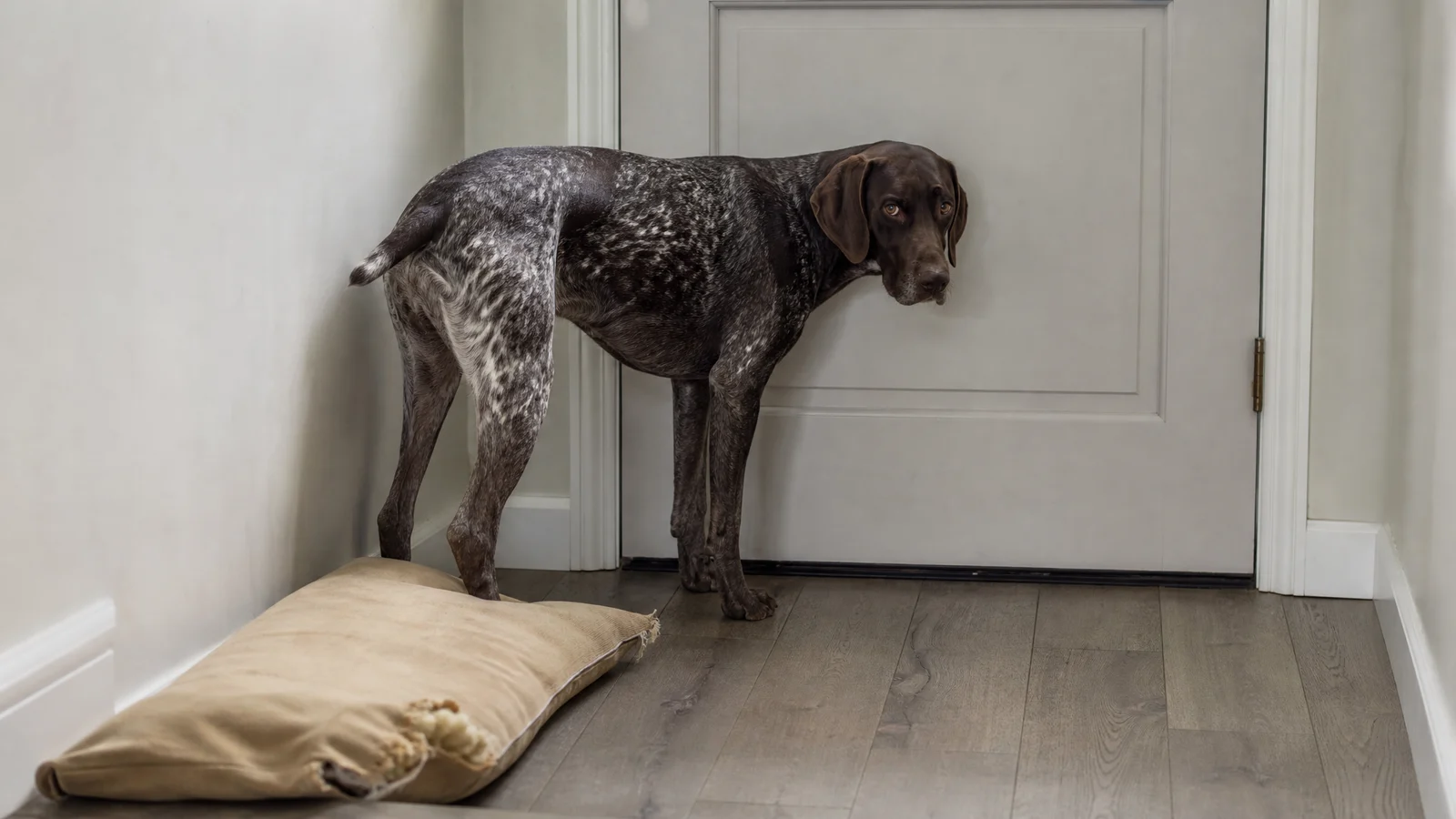
A German Shorthaired Pointer who trails you from room to room is showing the best of the breed, and the empty house is where that devotion gets tested. If your GSP is the one struggling with it, the way through is slow, kind practice that makes your leaving something they can rest through.
Read on for how to tell real distress from a dog with energy to spare, how to shape a day that makes resting easier, and how to build short absences your GSP can handle. We also cover what to do when a settled dog starts struggling again, and when the vet or a behavior professional should lead.
Crate setup and door training have their own home in our GSP crate guide. This page stays with the distress itself and with the practice that eases it, because a crate can be part of a plan without being the plan.
Telling Distress From Energy When a GSP Is Alone
The first job is knowing what you are looking at, because a messy house does not say why the mess happened. A GSP has very high energy and needs a purpose, and without one they can turn destructive on their own, so a chewed cushion might be distress or it might be a dog with hours of unspent drive.
The pattern tells you more than the damage. Trouble that shows up almost only when you are gone, and that comes with signs of panic such as pacing, drooling, frantic barking or attempts to get out, points toward distress. Trouble that tracks with a skipped run or a dull day, and fades when your dog has something good to do, points toward energy. Plenty of dogs show a mix, and the quickest way to sort it out is to watch.
Watching the Recording Closely
Put a phone or camera in the room where your GSP stays and use a departure you already have to make, so you are not creating a hard absence just to test one. Signs of separation anxiety are often most severe within the first 15 to 30 minutes of a dog being left alone, so those minutes are the ones to study before you skim the rest of the video.
Your notes only help if they are specific. As you watch, jot down these four things:
- Before you go. Note whether your GSP follows you, paces or goes quiet as soon as the keys or the coat come out.
- The first half hour. Note whether barking, pacing, drooling or scratching at the door starts right away and how long it lasts.
- Settling. Note whether your dog ever lies down, and if so how long after you left it happens.
- Your return. Note how your GSP greets you and whether they are still keyed up or have gone back to resting.
Those notes show you where the trouble starts, which tells you where to aim the work. They are also exactly what your vet or a behavior professional will want to see if you need to ask for help.
Exercise and Brain Work Before Time Alone
Once you know what the first half hour looks like, the stretch just before it is the easiest part to change. A GSP has very high energy and a mind that wants a job, so the day your dog has had decides how much of that drive is still looking for an outlet when the door closes.
That matters because a tired dog has less energy available for destructive activities, and distraction can be a valuable tool. Food puzzles, aerobic exercise, interactive games and daily walks are the options in Texas A&M's pet-care guidance for keeping a dog busy.
Take that for what it is. A tired dog is a calmer starting point, not a cure, and as GSP people we read a dog who is still frantic at the door after a great run as a sign of distress, not surplus energy. That is the cue to keep working through the steps below instead of adding more miles.
Here is how we shape the hour before leaving. Each piece has a reason, so you can drop any piece that does not fit your day:
- Movement first. Do the hardest exercise early, using the plans in our GSP exercise needs guide, so the heavy breathing is over well before you reach for your keys.
- A nose game. Follow with a slow sniff walk from our GSP sniff walks ideas, or scatter a handful of kibble in the grass, because mental work tires a GSP in a different way than running does.
- A quiet wind-down. Let your dog drink, sniff around the house and settle before you go, because a dog who is still revved up cannot be a relaxed dog when you leave.
Settling a German Shorthaired Pointer Away From You
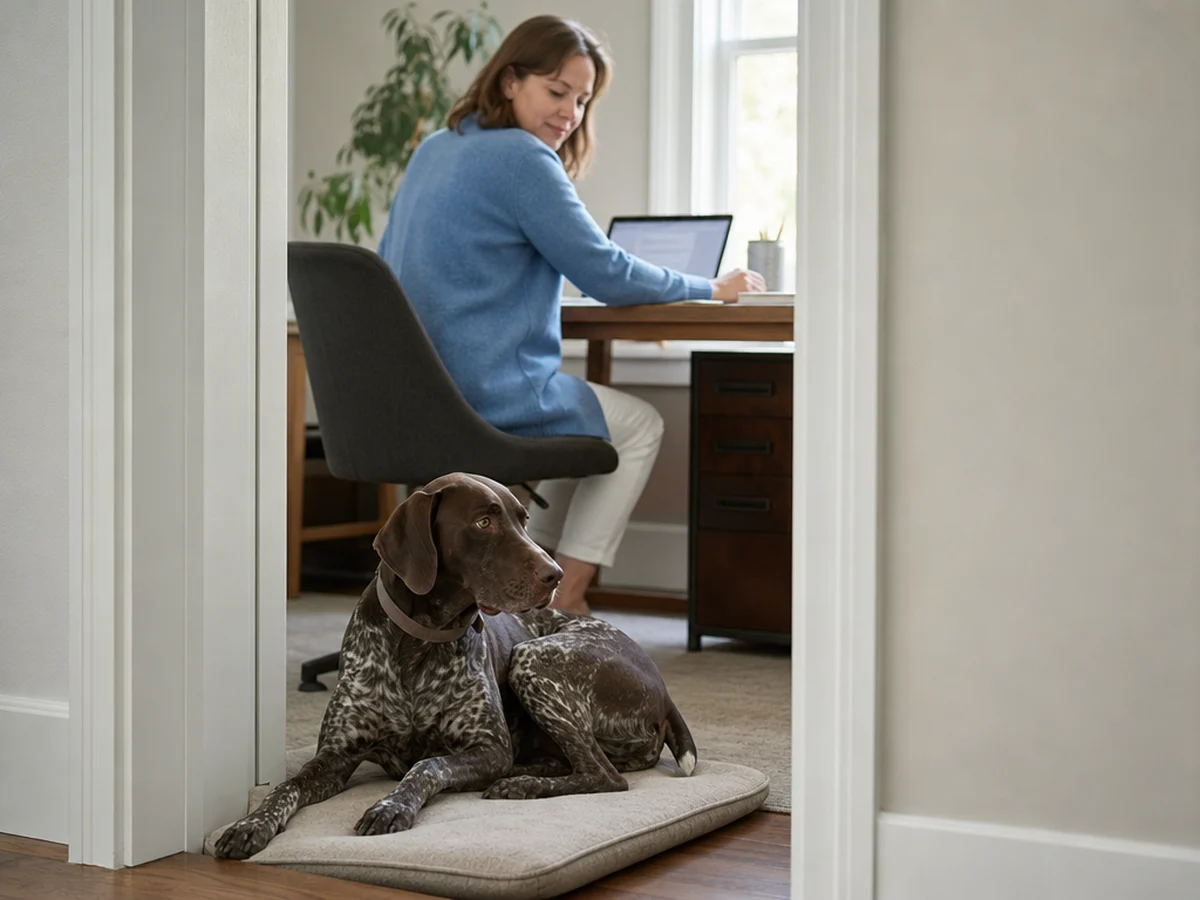
A GSP who has had a good day still needs to know what to do with the quiet, and settling is a job you can teach while you are home and relaxed. This breed bonds firmly to the family and loves having a purpose, so a clear assignment on a mat works better than hoping for a nap.
Choose one mat or bed and keep it where your dog can see you at first. Each rung below has a reason, so you always know why you are adding the next piece:
- Reward lying on the mat. Mark and pay whenever your GSP steps or lies down on it, with no cue yet, so the mat itself becomes the good thing.
- Add time. Pay in the same spot while your dog stays down, waiting a little longer between treats, so staying becomes the way to earn more.
- Add small movements. Walk to the sink or sit in a chair and pay each stretch of lying still, so your motion stops ending the lesson.
- Step out of sight for a breath. Go around a corner, come back before your dog gets up and pay on the mat, so your return becomes the best part.
- Add a chew. Offer a chew from our GSP chew toy ideas or a stuffed food toy while you are home but busy, so the mat predicts something worth settling for.
If your GSP pops up at any step, the step was too big, so make it smaller and pay more often. A dog who settles while you move around the house has the skill the next section asks them to use at the door.
How to Treat German Shorthaired Pointer Separation Anxiety
With settling in place, the door finally has something to predict, and that is where the real change happens. We build it in three moves: take the sting out of the cues that announce a departure, practice exits shorter than your dog's worry, and know when to stop.
Departure Cues You Can Blunt
Your GSP probably already knows you are leaving before you do. Keys, shoes, a jacket and the sound of the garage can each set off pacing or whining, which means the worry starts well before the door closes. Pick those items up at random times during the day and put them back down, wear your jacket while you make dinner and jingle your keys in front of the television, so they stop predicting a departure.
Then change how you actually leave. Skip the long goodbye, give your dog a stuffed chew or food toy a few minutes ahead of time, and sit quietly for a short while rather than rushing out. A calm start gives your GSP less to react to.
Short Exits and Quiet Returns
Treat each stage below as its own lesson, and move on only when your GSP stays loose through several exits in a row, with a soft body, no pacing and a quick return to the mat. A stall means the stage was too big, so shrink it and pay more often.
- Door touch. With your GSP on the mat, stand, touch the knob and sit back down, then drop a treat on the mat if your dog stayed put. If they get up, shrink the step to just turning toward the door.
- Open and close. Open the door a hand's width, close it and return to the mat, paying calm as you sit. If your dog follows you, go back to touching the knob.
- Step out and back. Go outside, close the door and return within a breath. Give a brief hello, sit near the mat and pay once your dog is resting. Stalls call for exits shorter than a breath.
- Add seconds. Stay out a few seconds, then a little longer, mixing a short exit with a longer one so lengths stay unpredictable. Pacing or drooling on the recording means the last length was too long.
- Add the full routine. Pick up keys, put on your jacket, start the car and come back, then drive around the block as each version stays easy.
When Practice Makes Things Worse
Sometimes a plan that looks right leaves your GSP worse off. VCA Animal Hospitals explains that some dogs, instead of adapting and relaxing, become distressed more and more quickly, and that further training can be detrimental for them.
A veterinary behaviorist is the person to consult in that case. That gives you a simple stop rule.
If your GSP is more upset on the third try than on the first, or takes longer to recover after each one, pause the practice and ask for professional help. Pausing is not giving up, and it keeps the practice from teaching the wrong lesson.
Our trainers would rather you stop a good session early than finish a hard one, because a dog who is still relaxed at the end learns that exits finish well. Quit while your GSP is still loose, even when you could have gone longer. While you wait, someone else needs to cover the hours you cannot practice, whether that is a family member, a sitter or a day program. Covering those hours is what keeps the work you have done from being undone by one hard afternoon.
When a GSP Who Coped Alone Starts Struggling
A plan that worked can still slip, and the cause is not always something you did wrong in training. A move, a new work schedule, someone leaving the household or a change in the sounds and layout of the home can all shake a settled GSP's confidence about being alone, and the old behavior can come back.
If the change arrives without an obvious reason, call the vet first. Pain, itching, illness and discomfort can all lower a dog's threshold for anxiety and should be ruled out, so frequent anxious behavior deserves a vet visit as soon as possible, as Tufts' veterinary school guidance puts it. Keep regular vet visits on the calendar even when things are calm, so a baseline already exists when something changes.
After your vet has weighed in, restart with exits so short they feel almost silly, and lengthen them only while your GSP stays loose. The earlier success is proof that your dog can learn this, and a smaller start protects that proof.
Practical Questions About Leaving Your GSP Alone
The steps above assume one dog and one person leaving a quiet house. Three everyday details can change how you apply them, and each one has a short answer.
Must my GSP be crated while I am out?
No. A crate is one tool, and the right choice depends on the dog: a GSP who happily rests in one may do well there, while a GSP who fusses or tries to escape may be calmer in a gated room with a settle mat. Whichever you choose, the rest of this page still applies.
Why is my GSP fine with my partner home?
Some dogs stay calm as long as anyone is in the house, while others are unsettled when one particular person is gone, even with company. If your GSP is the second kind, the missing piece is you, so the practice has to include your absence in particular. Ask your partner to run the mat sessions while you step out, so your dog learns to settle while you are gone and someone familiar is nearby.
Does a window view make it worse?
It can, if people walking by or passing cars keep your GSP wound up. Block the view with window film or a closed door, and set the mat in a room without a street view, so there is less to react to.
A Calm German Shorthaired Pointer When Alone
Each answer above comes back to the same quiet skill. Drive gets most of the attention with a German Shorthaired Pointer, and rest gets very little, yet rest is a skill like any other: it can be taught, it can be rewarded, and it is exactly what an empty house asks of a dog who has always had you nearby.
That is why alone time is worth treating as the resting half of your GSP's day, not a gap in it. A day built with movement, mental work and a place to settle gives the hours you are out a job of their own, and a dog with a job is a dog you can leave with far more confidence.
The same patient approach carries into everything else a GSP has to learn, and our e-book, yours at no cost, follows it through every one of those needs in a complete but approachable read.
 BehaviorGerman Shorthaired Pointer Leash Reactivity: What Helps
 BehaviorHow to Stop a German Shorthaired Pointer Pulling on the Leash
 Exercise and jobsEasy Tricks to Teach a German Shorthaired Pointer
