 GSP
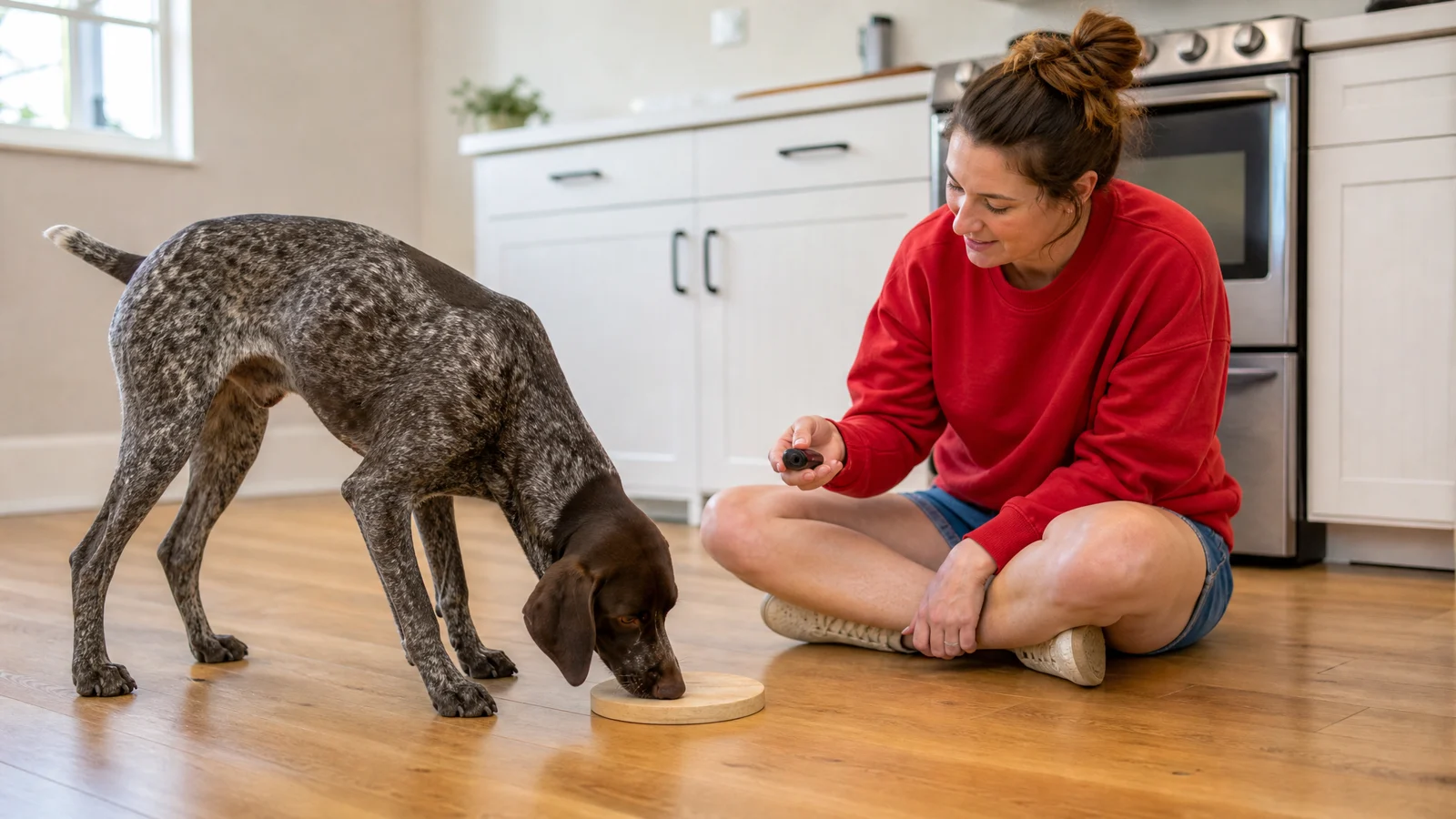
If you want your German Shorthaired Pointer to pick up new skills without endless repeating, a clicker is a handy tool to learn first. One short sound pinpoints the exact thing you liked, and food follows right behind it. In this guide you'll see what to gather, how to teach the sound its meaning, which behavior to click first and how to take the lesson beyond the kitchen.
German Shorthaired Pointers are keen, willing to please and happiest with lots of play and attention, so there is plenty to work with. They also do best with something to do, and a clicker turns training into a game with rules both of you can follow, even if neither of you has trained this way before.
What to Gather Before the First Click
A clicker lesson needs very little equipment, and most of the choices come down to what your dog finds worth working for. Two decisions matter most: the sound you will use and the reward behind it.
Start with the marker itself. A clicker sounds the same every time, while a spoken word such as "yes" leaves your hands free, and either one works as long as it never shows up in ordinary conversation. Our trainers lean toward the clicker for early lessons because its sound never changes with your mood.
Rewards come next. Small, soft treats that your dog can swallow quickly keep the lesson moving, and a GSP's love of play and attention gives you extra options, such as a short game or a bit of fuss. Keep a few of them in rotation, since the reward that lights up your dog on a quiet morning may not be the one that works after a long walk.
Finally, choose a quiet room with the door closed. A calm, plain space lets the sound stand out against the background, and that is what the first lesson needs most.
Who Uses the Clicker and What It Is Never For
Gathering the gear raises two practical points that are easier to settle before any treats come out: who handles the sound, and what job it is allowed to do. Both have short answers, and settling them now saves muddle later.
Can Children Help With the Clicker?
Yes, once the sound already means food to your dog. Handle the first pairing sessions yourself, then let children take short turns while you stand beside them and keep the treats. The rule is the same for everyone: a click means this moment, and food follows. Store the clicker in a drawer or pocket between sessions so nobody clicks it for fun.
Can a Click Stop Unwanted Behavior?
No, and it is not meant to. The click marks a moment you like and tells your dog food is on the way, so it builds behavior rather than ending it. When something at home is a problem, picture what you would rather see in its place and click that instead.
Teaching Your GSP What the Click Means
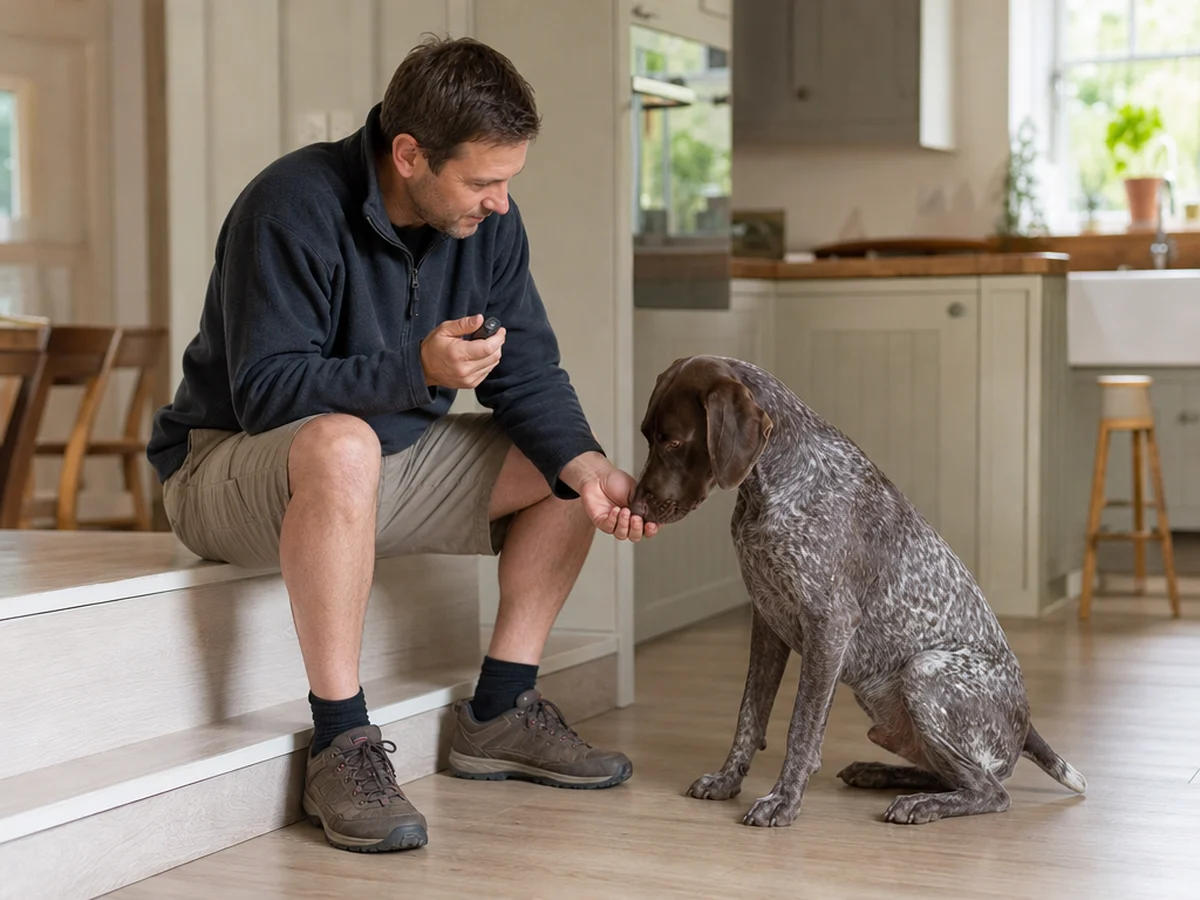
Until your dog hears food in the sound, it is only noise, so the first session is about building that link and nothing else. Sit or stand with your dog nearby and the treats within reach. Click once, hand over a treat straight away, and repeat after a short pause, whether your dog is sniffing, standing or looking at you. A click with no treat behind it gives a dog no reason to listen for the next one.
Your dog will understand that the marker predicts a coming reward after about 10-20 repetitions of click, then treat, which is the pace the American Kennel Club describes for this first stage. That pairing is also the reasoning behind AKC's rule that the click must mark the correct moment and every click must be followed by a reward.
You will know the link has formed when your dog turns toward you, or toward the treat hand, as soon as they hear the click rather than after the food appears. Once that turn becomes dependable, you can start asking for something.
Marker Training a German Shorthaired Pointer's First Behavior
A sound that predicts food now needs something to mark, and the best first choice is small, easy to see and something your dog does willingly. Think of it as a warm-up for both of you rather than a test.
The Dumb Friends League suggests that anyone new to clicker training start with hand targeting, eye contact or capturing attention, and recall behaviors. Hand targeting is the easiest of the three to watch happen: hold a flat palm close to your dog's nose, click the instant their nose touches it, and feed from your other hand.
Once the nose-to-palm touch is steady, the click can mark behavior in three ways, and it helps to know which one you are using so you always know what you are asking for:
- Capturing: click a calm moment your dog offers on their own, such as settling on a mat or standing with four feet on the floor when someone walks in. Our GSP jumping guide builds on that idea for greetings.
- Luring: use a treat to guide your dog into position, click when they arrive and then fade the guide.
- Shaping: click small steps toward the finished picture and raise the bar a little at a time.
Capturing deserves extra attention with a dog this energetic, because it lets calm earn clicks as often as action does. That balance keeps the clicker from turning every session into a revving-up exercise.
Clicker Training for German Shorthaired Pointers Beyond the Kitchen
A first behavior that works in the kitchen is only the start, because the click has to keep landing on time as the setting gets busier. That makes the work from here less about new tricks and more about keeping each click honest.
With an active GSP, the behavior can be over before you decide to click, so keep your thumb ready and watch the dog rather than the treat bag. The American Animal Hospital Association advises rewarding your dog immediately after the desired behavior to help them connect action and reward, and it explains that a verbal marker or clicker can show a dog exactly which behavior is being rewarded by clearly pinpointing the exact moment.
Keep the treats in a pocket or pouch until after the click, so the sound, not a visible treat, tells your dog that a reward is coming. Regular vet visits stay part of the picture too, since training goes best when your dog is comfortable and feeling well.
Make the lesson harder in small steps. Move from the kitchen to the yard, then to a quiet street and later somewhere busier, and if your dog stops responding, return to the last place where the clicks were landing easily.
Our GSP exercise and brain games guide has more ways to give a clever mind a workout, and our German Shorthaired Pointer training guide shows where the clicker fits in your wider routine.
Picking the Right Way to Mark Each New Lesson
Once the kitchen, the yard and the quiet street all work, the next question is less about the clicker and more about which of the three ways to use it fits the lesson in front of you. A calm settle on a mat is a capturing job, because you are marking something that already exists.
A sit or a down is a luring job, since a treat can guide your dog into the picture. An idea with several parts, such as a tidy greeting at the door, is a shaping job, built from small steps that each earn a click. Deciding which method you are using before you pick up the clicker keeps the session clear, because you always know what the next click is paying for. Stay with one method for the whole lesson and your GSP gets a game with clear rules.
Our free e-book walks through German Shorthaired Pointer training from start to finish in plain, step-by-step language, so the next lesson never has to be planned alone.
 BehaviorHow to Fix German Shorthaired Pointer Separation Anxiety
 BehaviorGerman Shorthaired Pointer Leash Reactivity: What Helps
 BehaviorHow to Stop a German Shorthaired Pointer Pulling on the Leash
