 GSP
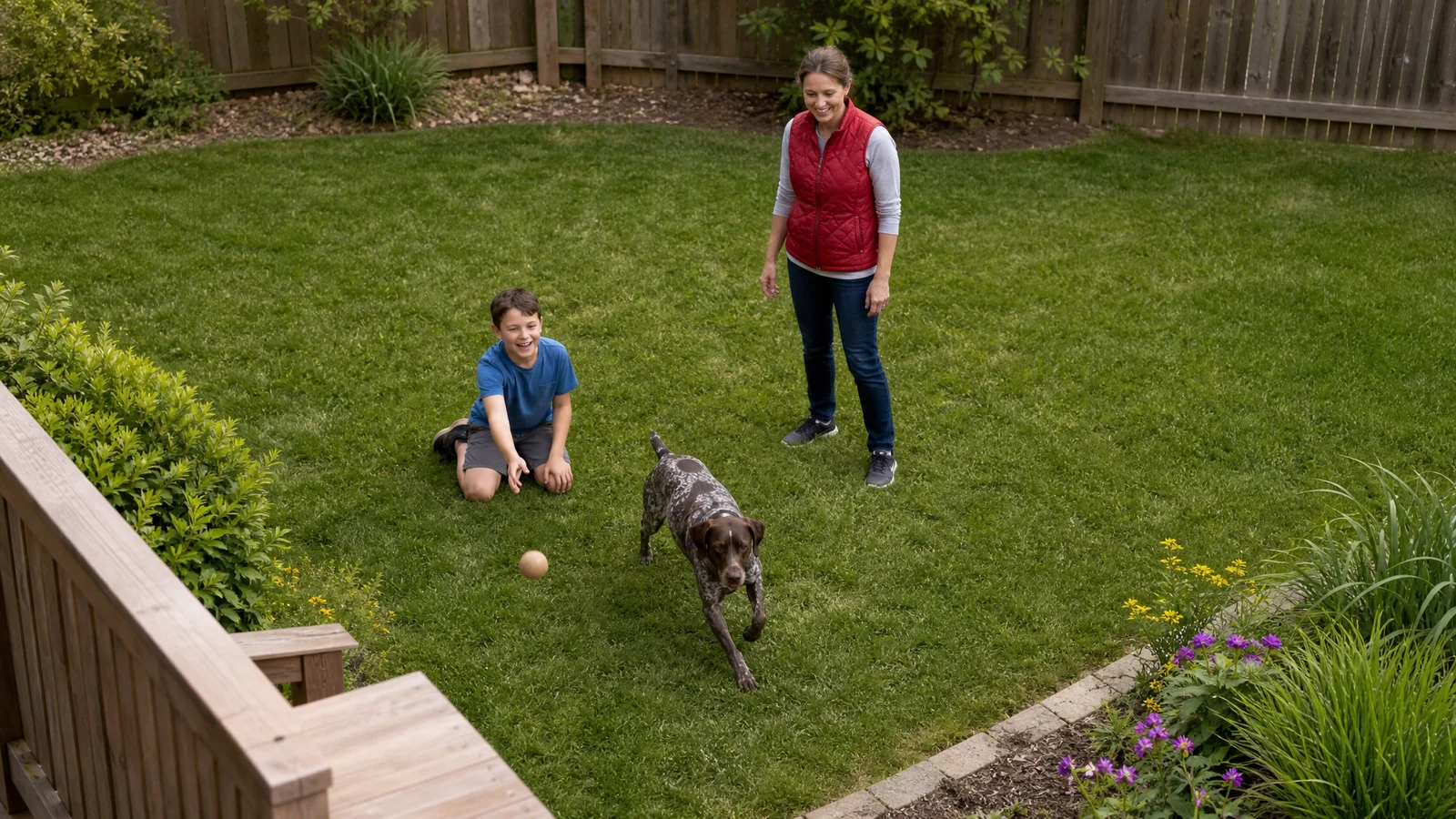
Parents who look this breed up usually find the same good news: the German Shorthaired Pointer has a reputation as a warm, family-minded dog. That news is real, and it is only a head start.
What decides how the first years go is the setup around your child and your dog: who is watching, what each age is allowed to do, where the dog can rest and what the games look like. Below, you'll find that setup in order, along with the rules for visitors and the questions parents ask most.
The honest hard part is energy, because a keen GSP can be a lot of dog for a small person. We cover that too, so nothing catches your family by surprise.
Where a German Shorthaired Pointer Fits in a Home With Kids
Start with what the breed brings to a family, because it explains both the appeal and the risk. On the American Kennel Club's trait ratings the breed scores 5 of 5 for being good with young children, where 5 means Good With Children, and 5 of 5 for affection with family. The same ratings put energy at 5 of 5.
Put those numbers together and the picture is a dog who adores people and has plenty of motion to spend on them. That is lovely when the motion goes into a game, and less lovely when a bouncy greeting meets a toddler's balance. No ill intent sits behind a knock-over, but a small child feels it all the same.
So we treat the ratings as a promise about the dog's heart, not a guarantee about the dog's manners. The heart is the easy part. The manners come from the way your household is arranged, and from keeping that arrangement steady through the adolescent months, which the teenage months guide walks through for the dog's side of training.
Supervision That Works for Kids and a Busy Dog
A breed that rates this well still needs an adult in the room, so the first decision is who that adult is and what watching actually means. Adopting a dog "for the kids" is an unrealistic plan, as this guide to kids and dogs spells out: the adult stays the dog's main caretaker, and keeps watching the children's friends and relatives as well as their own. Watching means eyes on both of them and a body close enough to step in, not a glance from the kitchen.
When that is not possible, dog and child are apart, and that is a plan rather than a punishment for either one. These are the moments where we separate them without debate:
- Cooking and phone calls. Any stretch where your attention leaves the room is a stretch for a gate, a closed door or the dog's own space, because the first sign of trouble is easy to miss from across the house.
- Meals and chews belong to the dog alone, so give them in a spot where no child can wander up to a dog who is eating or working on a bone.
- When play gets rough: wrestling, chasing and pulling all end the game for now, and the dog gets a break while the child moves to something calmer.
None of this means the two cannot be together often. It means the togetherness is something you arrange, which is what lets a loving GSP and a lively child enjoy each other without a close call.
House Rules for Kids, Sorted by Age
What a child can safely do changes with age, and one humane society's age-by-age guide draws its first line at about five. Up to that age the relationship stays mostly hands-off unless the dog clearly asks for attention, and from five on, children can learn dog body language and a three-second routine of petting, pausing and reading the dog, with lip licks, shaking off and yawns meaning it is time to walk away.
A GSP's friendly pull toward people makes it tempting to relax these lines, because a dog who loves everyone seems to need less managing. Each age below turns the guide into daily habits.
Children Up to Five
A toddler cannot promise to be gentle, and even a usually polite one will lunge at the dog on a bad afternoon, so the arrangement has to work without the child's cooperation. In practice that means a gate or pen between a floor-level child and the dog, and an adult who steers the child away when the dog has not asked for company.
The dog's enthusiasm makes this more important, not less, because a GSP will often walk straight over to say hello. If your child is set on petting, a stuffed toy that looks like your dog can give them something to practice gentle pets on first.
Children Five and Older
Now a child can learn the signals, and the three-second routine gives them something concrete to do. Pet for three seconds, take the hands away, and look at the dog. A nudge or a lean in means another three seconds, while a turned head, a lip lick or a walk-away means the child leaves the dog alone too.
Adults still stay close at this age. The routine teaches the child to ask the dog a question, and your job is to notice when the answer is no before the child does.
Teenagers With Real Dog Jobs
Teens can feed the dog, walk them and take part in reward-based training, and that shared work builds a real bond. They also relax quickly around a dog they know well, so they still need guidance about body language and about handling a strong, keen dog on a leash.
Whatever the age, a few rules hold for every child: nobody disturbs the dog who is eating, chewing or asleep, nobody hugs or lies on the dog, and nobody hits, pulls or yells at them.
When Your German Shorthaired Pointer Has Had Enough of Kids
Rules only work if an adult can tell when they are failing. Reading the dog is the skill that matters most once the setup is in place, and it starts with the growl.
A growl is the dog's way of saying something is wrong, and the right response is to ask what is wrong and help the dog out of the situation. Punishing a growl teaches the dog to stop warning you, which leaves the child with no advance notice at all. If a dog who used to be relaxed becomes touchier with the children, mention it at your regular vet visits, because a dog who is uncomfortable may have less patience than before.
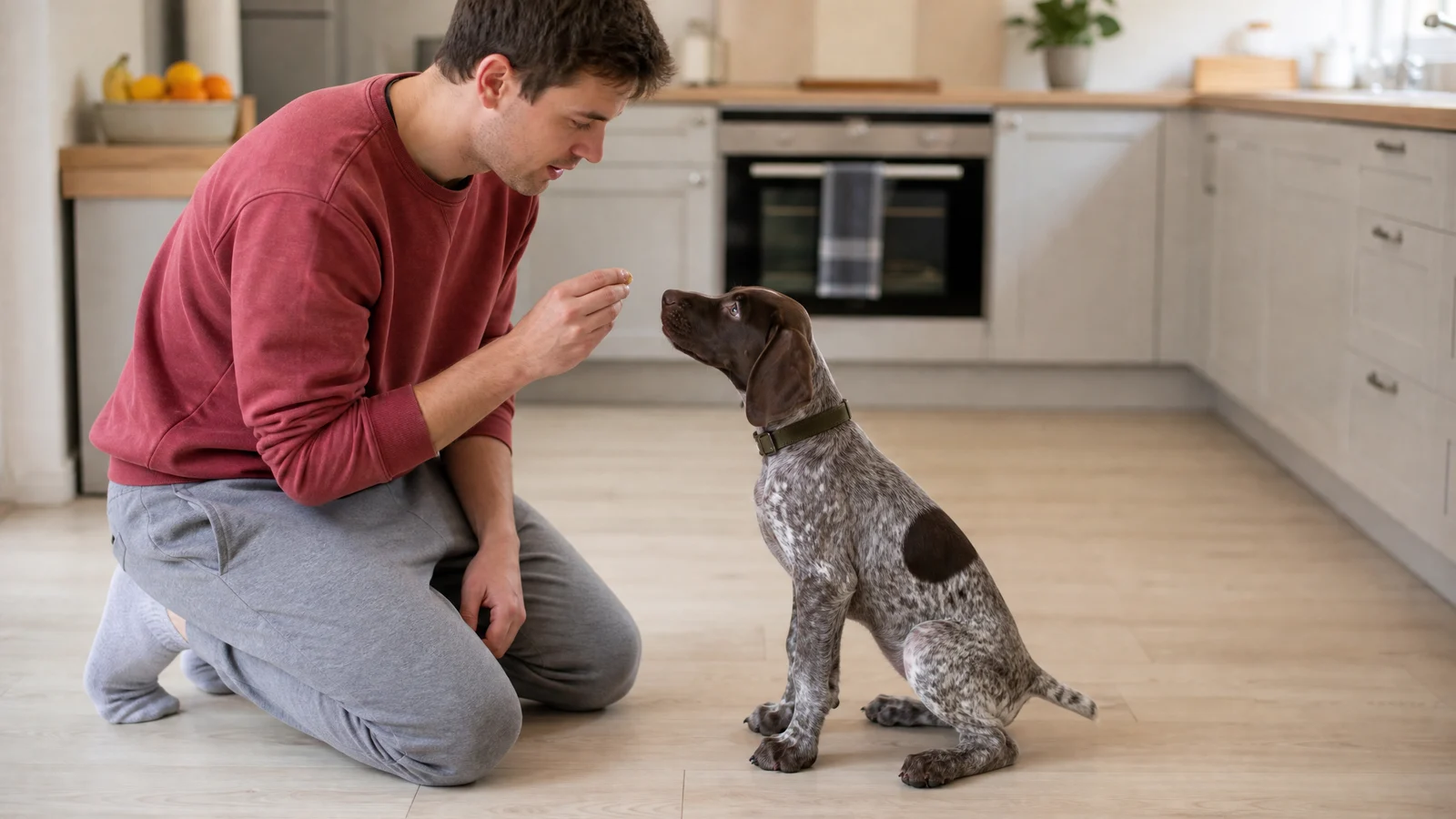
Children also hug dogs around the neck without thinking, and a dog may read that as a threat. A gentle scratch under the chin works better, and staring into a dog's eyes is best left out. Treats go on a flat open palm so no small fingers are in the way when a keen dog lunges for them.
Fast, jerky, squealing movement can set off chasing, heel nipping or jumping in any dog, according to this children-and-dogs guide, and a GSP's energy gives those habits plenty of fuel. Most younger children cannot deliver an "easy" or "leave it" cue themselves, so that cue is yours to teach and use. The child's own job is to stand like a tree, hands folded and eyes turned away.
A Retreat for Your German Shorthaired Pointer and Visiting Kids
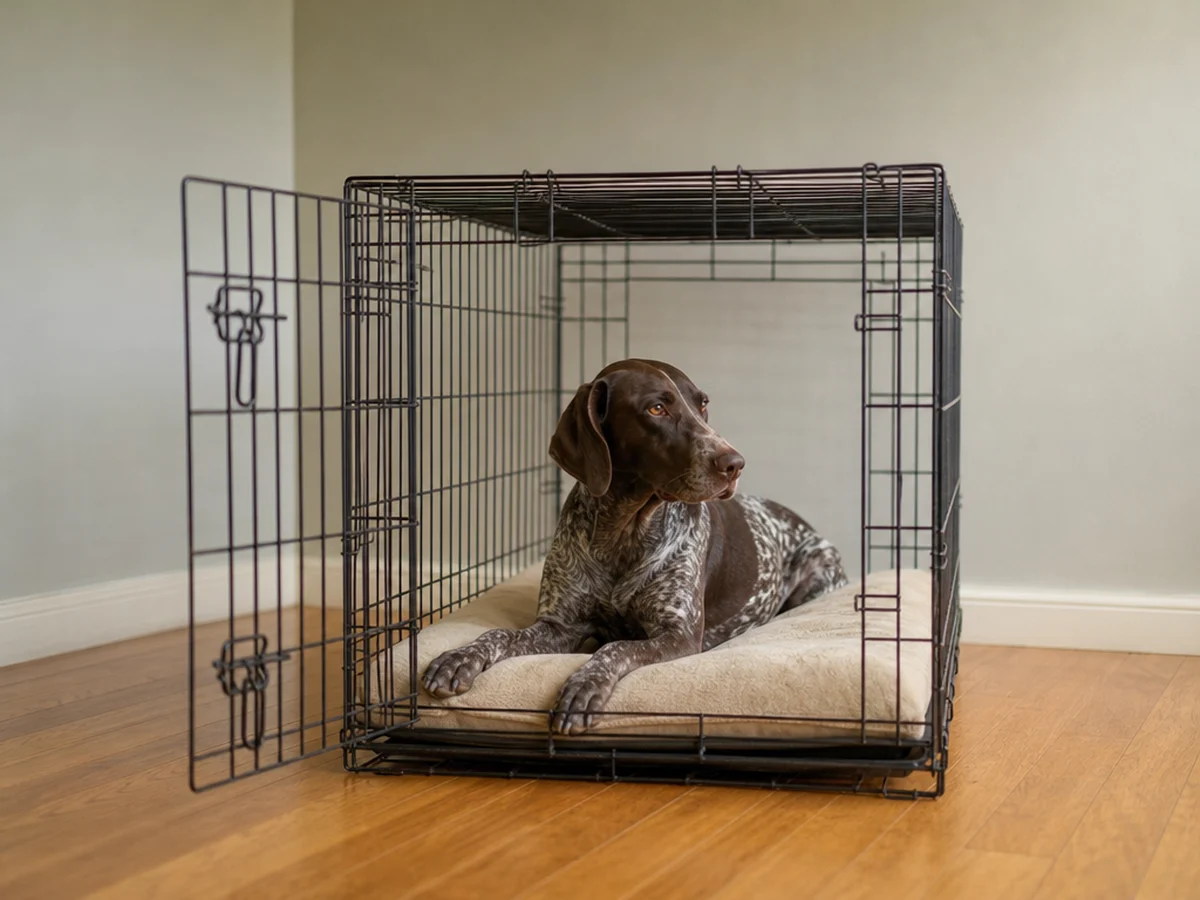
The most useful thing you can give a family dog is a place where children do not go. A people-loving dog like a GSP may stay in the middle of the action until somebody ends it, so the space has to be something you offer, not something the dog is expected to ask for.
Setting Up the Space
Pick a spot where the dog can still hear the family but children cannot reach them: a gated corner, a pen or a room with a baby gate. Stock it with a comfortable bed, water and a chew or food puzzle, and add a crate if your dog likes one; our crate comfort page covers building that.
Use the space for scheduled breaks, for meals, and any time the energy in the house climbs. For the children, the rule is simple: when the dog is in there, the dog is left alone. A big stop sign on the gate helps young ones remember.
When Friends Come Over
A dog who is easy with your own children is not guaranteed to enjoy visiting ones, who bring new noise and no habit of reading your dog. Tell visitors the rules at the door: ask first, no chasing and no hugging. If the energy in the room rises, the dog goes to the retreat until it settles.
Never leave the dog alone with any child, your own or a guest's, and never hold a dog in place so someone can pet them. A dog should always be free to walk away from a child, and a GSP who is allowed to leave early is much more likely to stay friendly.
Games Kids and a GSP Can Share
Safe rules leave plenty of room for fun, and a keen dog has a lot to offer when the activity gives the energy somewhere to go. Shared time works best when the two are doing something together without being on top of each other.
- Side-by-side time: give the child art supplies at a table and the dog a snuffle mat or stuffed chew across the room, so both stay calm and nobody feels pressure to touch.
- Fetch with a drop cue. Play only once the dog reliably lets go of the toy, the child never tugs it from their mouth, and a longer toy keeps teeth away from small fingers.
- Walks together give a shared outing with attention off each other, and young children never hold the leash alone, and our sniff walks page has easy ideas.
- Training with an older child: reward-based sessions with an adult beside them teach the dog to look to the child for cues, and teach the child to be clear and patient.
Before any of these, take the edge off the dog's energy with a walk or run, because a dog who has already spent some motion is a better partner for a quiet game. Children can also build the dog's puzzle toys from boxes and stuffed chews, which gives them a real role even on days the dog would rather not be touched.
Parents' Questions About a GSP and Kids
Three situations come up around the edges of a family day that the sections above only brush against. Here they are one at a time, answered the way we would answer a parent at the door.
What if my GSP chases running kids?
Stop the game and guide the dog to the retreat with something to chew, rather than scolding. Move the children's wildest running outdoors or to times when the dog is resting. Practice "leave it" away from the kids first and pay the dog for turning toward you, and bring in a reward-based trainer if nipping continues.
Will my GSP chew my kids' toys and socks?
A dog cannot tell a child's plush toy from their own chew unless you teach the difference, so keep playthings off the floor and skip handing over old socks or shoes. When the dog grabs something wrong, call them away and trade for an approved chew; our chew toys and chewing manners page has the details.
What about excitement when school lets out?
Start the dog in the retreat or on a mat, and let the children drop their bags before anyone says hello. Greet the dog only once all four paws are on the floor, and pay calm behavior with a treat. Our jumping manners page builds the skill that makes this easier.
One Calm Move Kids Can Use Around a GSP
Everything above is an adult's job, but your child still needs one thing of their own, and it has to be small enough to remember when a big dog is excited. Standing still like a tree, hands folded and eyes turned away, gives a bouncy dog less to react to.
Rehearse it away from the dog first, as a statue game in the hallway: the child freezes on your word and then calls for a grown-up. Practiced as a game, the move is ready when it matters, and a dog who keeps meeting still, quiet children is learning something useful about kids.
A calm child and a calm GSP are built from small, repeatable moves. Children and a keen GSP are both still learning, and our e-book takes the dog's half of that from the very first lesson onward, landing in your email after a quick registration on this page, with nothing to pay.
 Training basicsHow to Choose a German Shorthaired Pointer Trainer
 Training basicsGerman Shorthaired Pointer Temperament and Trainability
 Puppy trainingGerman Shorthaired Pointer Puppy Timeline: 8 Weeks to 2 Years
