 GSP
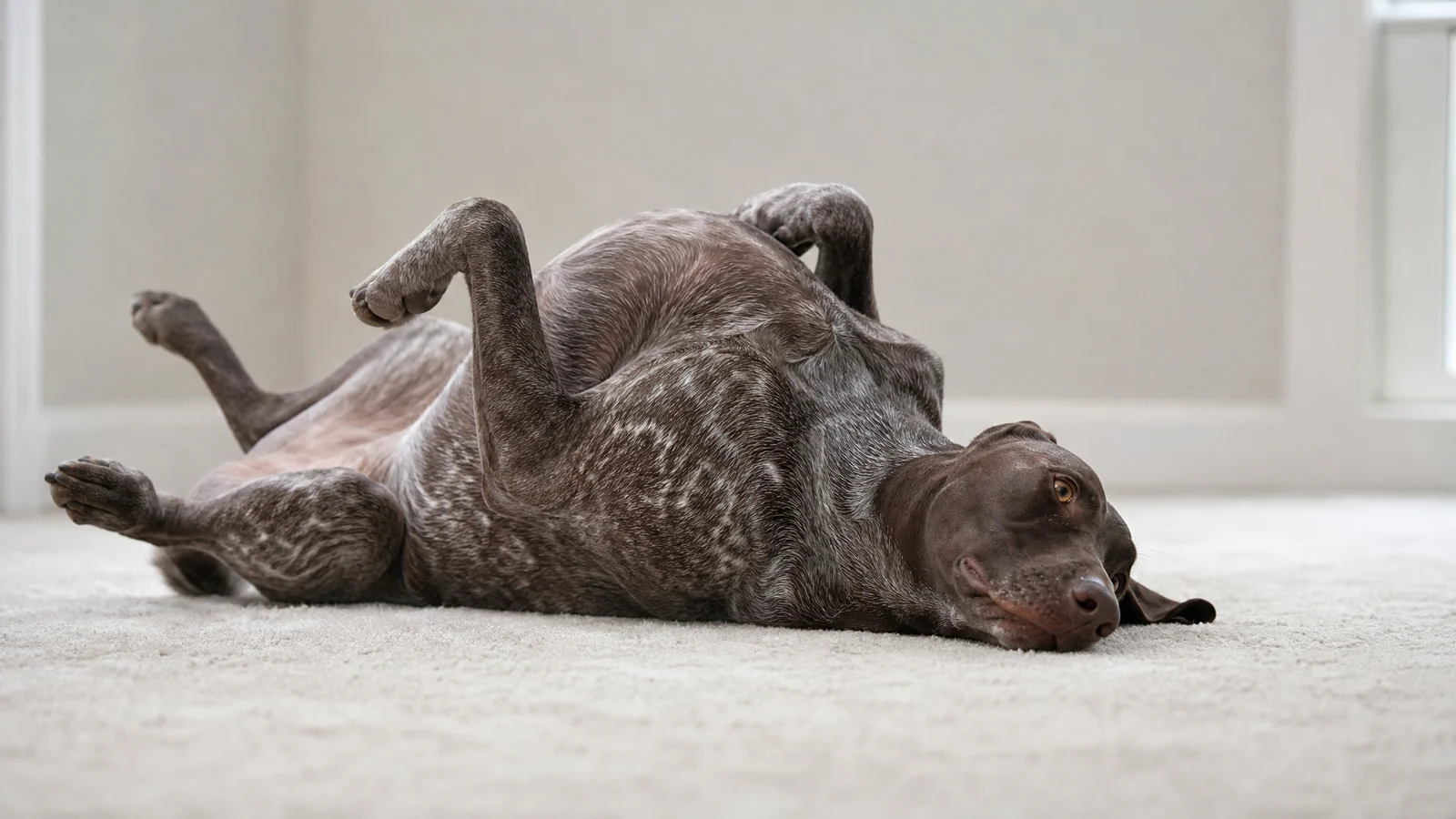
The first try at roll over often goes the same way: the treat sweeps past your GSP's nose, and a keen dog springs up to chase it instead of turning with it. That is not a failure of the lesson, only a sign the path asked for too much at once.
The fix is to stop treating roll over as one move. It is a path your treat draws across your dog's body, from a down onto a hip, over the back and on to the far side, and a dog learns that path far more easily in pieces than in one sweep. This page teaches each piece on its own, with what your hands do, when to pay and what to try when your GSP stalls, then adds the word and takes the trick into new rooms.
Some dogs never love lying on their back, and that is fine. A comfortable side lie is a finished trick of its own, so you have somewhere good to stop at every stage.
How a Roll Over Differs From Other GSP Tricks
Being able to stop at the side lie says something about this trick. Most tricks ask your dog to do something with their feet, while roll over asks them to give those feet up for a moment, which is why the dog who spins on the first try may need real patience here. A fast, keen GSP tends to treat the first hip tip as the start of a race, and we tend to see the roll go smoothest when the treat moves far slower than the dog expects.
The path itself is easy to describe. Your treat leads your dog's nose back toward a shoulder, then toward the backbone, then on to the far side, and the body follows. This AKC roll-over lesson draws the same route, and in its words it is helpful if your dog knows the "down" cue before you start teaching this trick, so a reliable down is the doorway into everything below.
Choose the floor before you pick up a treat. A rug or a folded blanket gives a back and hips some cushion, and a slick floor makes a dog scramble for footing, which is the opposite of the loose body this trick needs. Watch your dog's face as well. If they stiffen or look away when the treat heads for a hip, stay at an easier stage, and mention the reluctance at your next regular vet visit instead of pushing past it.
Teach a German Shorthaired Pointer to Roll Over, Stage by Stage
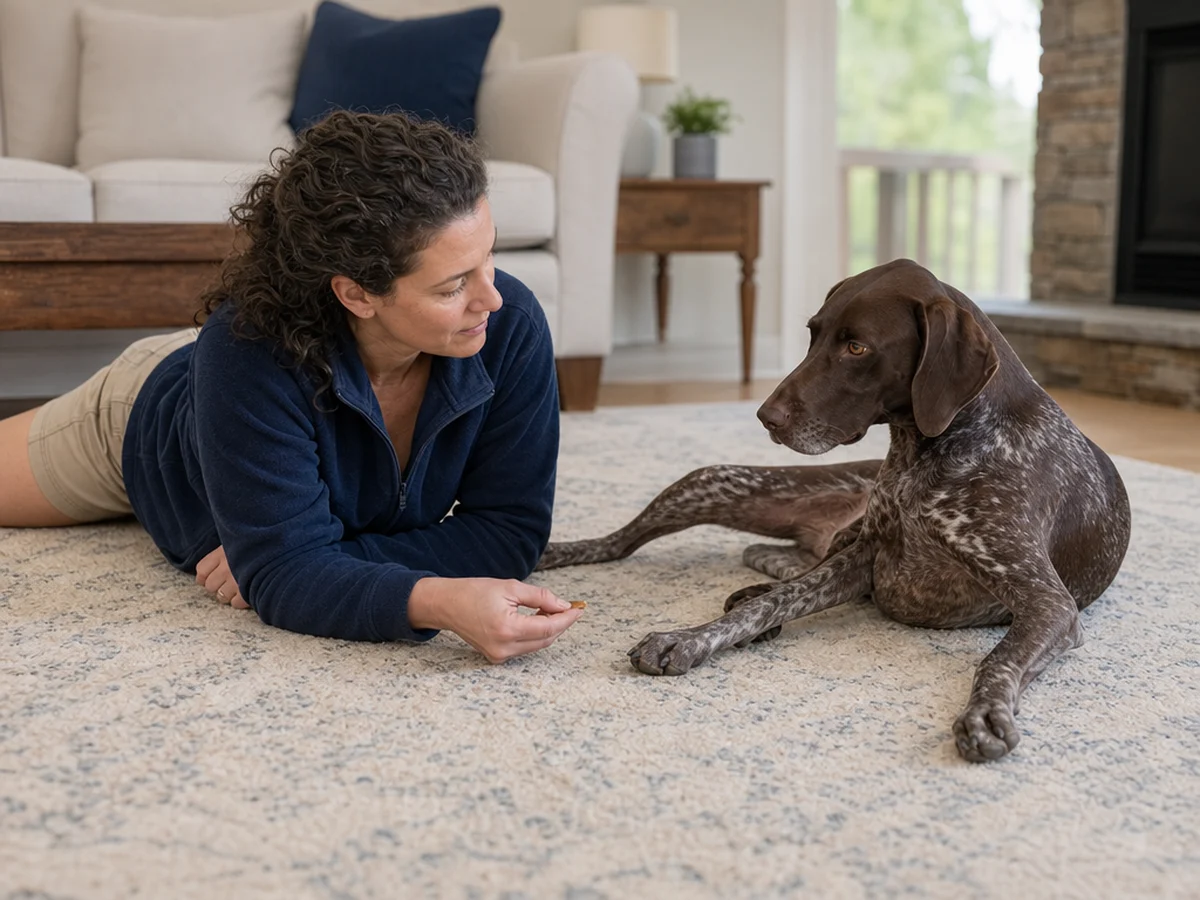
Because the path asks for three separate things from the body, each one gets its own stage here, and you move on only when the current stage looks easy. Cut the treats small and soft so they disappear in one bite, and stop each session while your GSP is still keen.
Down Into a Side Lie
This stage turns a dog lying on their belly into a dog resting on one hip, and it is where a keen GSP most often gives up early. Keep the first version tiny, because every later stage rests on it.
- Ask for a down, kneel beside your dog and let them smell the treat in your closed hand so they know it is theirs.
- Move the treat slowly back along the side of their head toward their shoulder, so the nose follows and their weight starts to shift onto one hip.
- The moment the weight settles, say your marker word or click, and pay at their muzzle while they are still lying down.
- Release them to stand, then ask for a fresh down before the next try.
Move on when your dog tips onto the hip smoothly several times in a row and rests there without a scramble. If they pop up as the treat moves, the lure went too fast or too high, so slow it, keep it low to the floor and pay for a smaller shift of weight. Adolescent GSPs pop up more, and the GSP teen-months guide covers keeping lessons easy through that stretch.
Side Lie Onto the Back
Now the back comes into it, and this is the stage where your dog tells you the most about how comfortable they are. That is also why your hands stay on the treat and off the belly: Michigan Humane's handling guidance for getting a dog used to vet visits is to avoid the belly, a sensitive area, so a trick that shows it off deserves extra care.
- From the settled side lie, hold the treat at your dog's nose and lead it slowly along their shoulder toward the backbone, close enough that their head follows it back.
- Mark and pay the first rock of the shoulders toward the floor, even if the back never touches down, and keep the treat low so they stay lying down to eat it.
- On each try, ask for a little more turn before you mark, until the back meets the floor and the legs go loose.
- Release, then restart from a fresh down so every try begins from the same easy place.
Move on when the back touches down smoothly several times in a row and the legs look relaxed, not braced. If your GSP scrambles upright or plants their feet halfway, the lure went past what they trust: return to the side lie, pay a few easy ones there and shorten the next sweep. A dog who stays at the side lie or a half turn has still learned a real trick.
Over the Back to the Far Side
The far side is where the trick becomes a roll, because the treat has to keep moving after the back stops being the destination. A keen dog will follow a treat that keeps going as long as it moves slowly enough to follow.
- Start with your dog on their back and the treat at their nose, then carry the same line on over the top of their body toward the far hip.
- Keep the treat close and slow, so their head stays pointed at it as the shoulders turn over.
- The moment their weight lands on the far side, mark and pay low, right where they are lying.
- Release, reset into a down and begin the next try from the side lie, not the back, so your dog sees the whole line each time.
If your dog stays on their back and waits, pause a breath, then lead the treat a little farther past their head and mark any shift toward the far side. If they swing back the way they came, the treat crossed too high or too fast, so trace a flatter, slower line. Move on when the far side arrives without coaxing several times in a row.
Joining the Three Into One Roll
With each piece easy, the work now is linking them, and the link is where the trick finally feels like a roll. Run the treat from the down through the side lie, the back and the far side in one slow sweep, and pay only when your dog has finished on the far side. Every piece was paid on its own before, so the dog already expects the pay to come at the end of the path.
If the sweep falls apart, pay the last piece your GSP completed and replay the join more slowly. A join that breaks at the back usually means the back stage wants a few more calm tries. When the full turn flows several times in a row, the lure has done its teaching and the word can go in.
Adding the Roll Over Word as Your Hand Gets Quieter
A dog who completes the whole turn reliably has learned the path but not yet the word, so the word joins last. Say roll over once, just before your hand starts to move, then lure as usual and pay at the end. Said at the same moment every time, the word comes to predict the hand, and in time it becomes what your dog answers.
Then the hand can get quieter. Swap the treat in your leading hand for an empty hand that makes the same sweep, and pay from your other hand the moment the roll ends, so the treat stops being the thing your GSP follows.
Shrink the sweep a little at a time, from a wide arc to a small loop of the fingers to a nod of the wrist, and go back one size whenever your dog hesitates. A dog who waits for a treat to appear in the leading hand is not stuck, only still following the old picture, so pay well for each smaller version until the wait fades.
Taking a German Shorthaired Pointer's Roll Into New Rooms
A roll that works on the living-room rug has been learned there, and a new floor looks like a new lesson to your dog. Begin in a spot with few interruptions and treat each new setting as a fresh start, because you will probably want to start indoors and move outdoors once the trick is mastered, in the words of SF SPCA's easy-tricks guide.
Change one thing at a time. Try a different room with the same rug, then a different floor, then a quiet corner of the yard on dry, soft ground, and drop back a stage whenever your GSP hesitates, because a roll that needs a fresh side lie on the patio is ordinary, not a step backward. A trick like this is also just one small piece of a day for a dog with this much energy, and the sports and jobs for GSPs page covers outlets that give that energy real work.
Straight Answers About Rolling Over
The same thing sits under every question below: what your hands do while your dog's body does the work. Each answer follows from that.
Can I turn my GSP over myself?
No. Pushing, pulling or flipping turns a trick into something done to your dog, and a dog who feels pinned on their back may stop trusting the position. Lure the movement with food and let their body choose to follow, and if it will not follow, go back to the stage before and make it smaller.
What if my GSP only rolls one way?
A dog can favor one direction, and that is fine to keep. Use the easier side for the cue, and give the other side its own short, easy sessions starting from the side lie, because the lure path toward the weaker side is a separate lesson.
My GSP grabs the treat too hard. What now?
Hold the treat enclosed in your fingers with only a corner showing, keep it close to the nose and pay from a flat palm once the movement is finished. Grabbing means your dog is stuck on the food and not the path, so slow the lure further and pay for a soft, relaxed muzzle.
What if my GSP stays belly up?
Staying put is not a problem to fix. Pay the calm in place, then give your release word and let them stand, so getting up becomes a cue and not an accident.
The Down Underneath Every Roll
One piece never got a stage of its own, and it is the one every stage stands on. A keen dog's down can be quick and springy, the body on the floor and the legs still loaded for whatever comes next, which is where most pop-ups begin. Pay a settled down, with the hips dropped and the dog truly flat, whenever you notice one in ordinary life, at the door, beside the couch or in the kitchen, and the rolls will start from a calmer place.
Down is only one foundation your GSP will need, and the free e-book we send when you join this site's list covers every other skill they have left to learn, fully and in words that make sense on a first read.
 Exercise and jobsHow to Teach a German Shorthaired Pointer to Weave Through Your Legs
 Exercise and jobsHow to Teach a German Shorthaired Pointer to Jump Over Obstacles
 Exercise and jobsIndoor Activities and Brain Games for a German Shorthaired Pointer
