 GSP
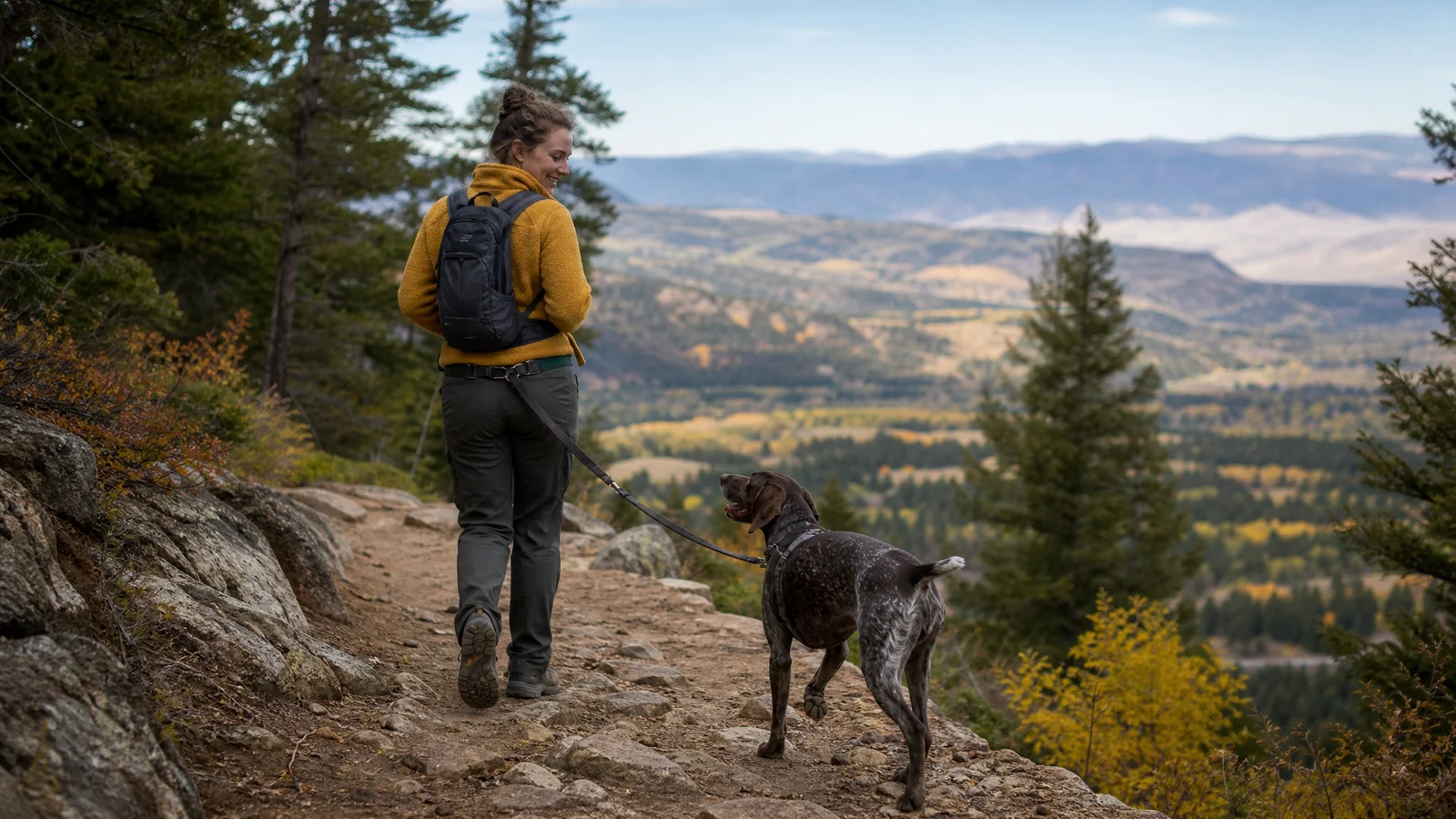
Physical readiness can appear before trail judgment. A German Shorthaired Pointer may have strength, speed, and endurance without knowing how to wait at a busy parking area, shorten pace on a descent, or turn away from wildlife. Those become trained decisions through clear, reward-based practice on familiar, easier ground.
This guide builds a hike from route design rather than a seven-step march, with the individual dog’s responses deciding each change. We will choose escape options, rehearse the trailhead, use distinct walking modes, redraw the plan around distractions, and judge the outing by the return home. Rewards keep connection valuable, while the leash and route protect a response that is still developing.
German Shorthaired Pointer Route Design for Hiking Training
Choose a first route for its options, not its destination. Look for a quiet start, stable footing, room to step aside, and several places to turn back. A short loop with choices teaches more than an impressive path that commits the team to crowding or difficult terrain.
The UKC breed description supports the breed’s reputation for strength, endurance, and speed. That broad description cannot tell you whether today’s dog is ready for heat, unfamiliar footing, or a long outing. Conditioning belongs to the individual.
Maintain regular veterinary care, and discuss a meaningful change in stamina, comfort, or movement before increasing activity. Age, conditioning, weather, and health all affect the plan. A general hiking guide cannot determine medical readiness.
Build from ordinary walks. Notice whether the GSP can turn with you, pause without surging, and respond to their name as the environment changes. The skills need not be perfect, but the route should leave enough space for the current version to work.
Use a compact route card before leaving. It is a decision aid, not a mileage target.
- Name the quietest entry and the simplest return route.
- Mark wide places where another trail user can pass.
- Identify shade, stable rest areas, and water access points.
- Choose an early turnaround that still feels like a complete outing.
- Note where a long line would be unsuitable because of roots, traffic, or narrow turns.
Pack a secure, comfortable walking setup, ordinary leash, small rewards, water, and route-specific supplies. Inspect the fit before departure. Extra equipment does not compensate for a plan that offers no safe exit.
A longer line can support recall work in an appropriate open area. Best Friends describes progression to a longer training line as recall improves. Rehearse that tool away from tight trails so it does not tangle around roots, people, or dogs.
Trailhead Training for a German Shorthaired Pointer
Parking areas compress movement and sound before the hike begins. A dog who bursts from the vehicle and drags toward the path starts with little attention available. Park far enough from the busiest flow to create a small orientation zone.
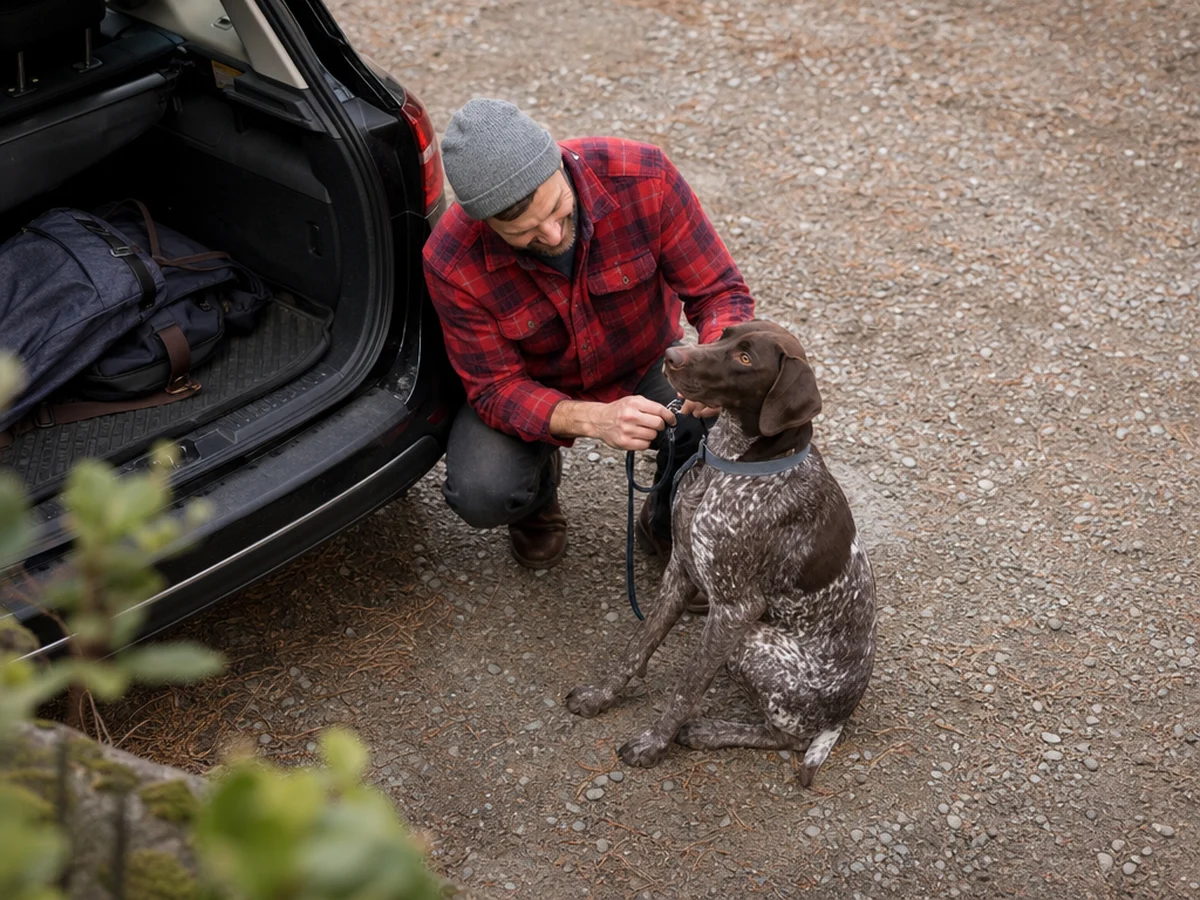
Check the dog again after a familiar walk’s excitement has faded. Ordinary movement and interest can inform the route note, while a meaningful change belongs in a veterinary conversation. Do not schedule harder terrain merely because the walk itself ended quietly.
A Departure Routine Creates Context
Pause after the dog exits safely. Reward one voluntary glance, check the equipment, and ask for a familiar brief behavior. Move toward the path only while the leash is manageable. Forward access can reinforce connection without turning food into the only useful reward.
When tension builds, stop or curve into an easier space. Reward the return of slack and begin again. The GSP learns that shared movement opens the route. Pulling produces no confrontation, but it does not become the quickest path to the woods.
When a familiar reward loses value and orientation disappears, move farther from the activity. Repeating a cue into the same difficult picture adds noise. A quieter position restores the chance to answer.
Passing Begins Before the First Bend
Hiking does not require greeting every person or dog. Establish a bypass cue near the trailhead, where you can move aside early. Reward the GSP for traveling with you while the other team passes, then release to sniff when space returns.
Keep greetings optional even when another person invites them. A predictable pass protects the dog’s focus and avoids blocking a narrow entry. Social success on a hike can mean calmly sharing space without direct contact.
The opening routine should remain brief enough that excitement does not accumulate in place. Several useful check-ins followed by calm departure are better than a long drill beside arriving vehicles.
Three Walking Modes Organize GSP Hiking Training
A single loose-leash rule does not describe every trail moment. Open ground, a narrow passage, and a pause ask for different positions. Teach three modes on familiar walks so the cue predicts where the dog should travel before terrain reduces your options.
| Mode | Handler Signal | Useful Trail Context |
|---|---|---|
| Explore | Release word and available leash | Wide, quiet ground with safe sniffing |
| Travel close | Position cue before the space narrows | Slopes, bends, bridges, and passes |
| Pause | Slow body movement and a stop cue | Route checks, water, and waiting |
Reward the transition, not only the position. Ask for close travel before a narrow section, pay promptly when the GSP changes mode, and release after space returns. An early cue gives the dog time to succeed.
On an uphill stretch, steady power can create leash tension without frantic behavior. Shorten the working distance before the slope and reward a pace you can share. Before a descent, slow earlier so momentum does not gather ahead of the handler.
Sniffing belongs inside the plan. Offer an explore cue on suitable ground, then call the dog into travel mode and reward. At safe moments, release back to the scent. Returning to you should not always close access to the environment.
Practice mode changes on both straight and gently curving familiar paths. The dog may understand a close position beside one leg but lose it when the handler changes direction. Reward the completed transition before asking for more distance.
A release should be as clear as the cue that brought the dog close. Without it, the GSP may drift between exploration and close travel. Defined permission lets sniffing remain available while protecting narrow sections.
The same exchange supports German Shorthaired Pointer recall. A return becomes more durable when it predicts worthwhile reinforcement and, sometimes, permission to resume a safe activity.
Distraction Planning in GSP Hiking Training
Movement, unfamiliar sound, and other trail users can change a workable route in seconds. Do not ask whether the GSP noticed. Ask whether they can notice and still eat, turn, or follow an easy cue. That response tells you if the current distance supports learning.
Distance Comes Before a Harder Cue
Battersea describes a dog’s response threshold through the distance where calm behavior changes. Use the idea before a dramatic reaction. A fixed stare, forward weight, or lost response can justify moving away.
Step into a safe side area, reverse direction, or wait where the dog can remain engaged. Reward reconnection and reassess the route. Distance is a practical tool, not a failure or a punishment.
A cue delivered after attention disappears may be familiar in name but unavailable in context. Change the map first. The dog learns that turning with you leads toward safety and rewards, while you preserve a dependable exit from crowding.
Recall Practice Keeps a Boundary
Outdoor enthusiasm does not make off-leash access appropriate. The RSPCA recommends a long training leash for outdoor recall practice, giving freedom short of full range. Follow local leash rules and choose management suited to the ground.
Use a fenced area for running when trail recall is unfinished. A broader GSP exercise plan can contain other vigorous outlets. One hike does not need to carry the entire physical workload or prove unrestricted freedom.
On the trail, reward unprompted check-ins before calling. Those glances show that the dog still tracks your location. A response that weakens around motion or scent tells you which safe practice environment to revisit.
A Surprise Can End the Planned Route
An off-leash dog, blocked path, sharp weather change, or unstable surface can remove the training space. Use the practiced turn and take the simplest safe return. Do not squeeze past merely because the original route continues beyond the problem.
After creating distance, ask only for behavior the GSP can still perform. A few steps together may be enough. Stacking extra cues onto a difficult event can turn the return route into another test.
Recovery Shapes the Next GSP Hiking Training Plan
The return offers a second kind of trail information. We compare useful behavior across the outing, then carry recovery details into the next route choice.
A destination reached is weak evidence of readiness. Look instead at leash quality, voluntary check-ins, response after surprises, and the ability to settle during a brief pause. An energetic dog can keep moving after useful training has ended.
Compare the dog at three useful moments. The pattern across those points is more useful than a single dramatic event.
- At the start, note orientation, leash quality, and stride.
- Midway, look at response and recovery after a pause.
- Near the finish, ask whether familiar mode changes still occur without repeated cues.
Turn back when the GSP repeatedly pulls, stops taking valued rewards, or recovers more slowly after encounters. Fitness answers whether the body can continue comfortably. Skill answers whether the dog can stay connected. Both must support extending the route.
Return by the easiest safe line and reward familiar walking modes. Skip new challenges on the way back. Turning around protects what the dog practiced and makes a future outing easier to plan.
At home, offer water, a calm transition, and a comfortable resting place. Observe whether ordinary movement and settling return. The hike is not complete merely because the vehicle door closed.
Write down the route conditions, the mode that weakened, and how the dog recovered. Avoid a rigid distance schedule. Repeating a comfortable route can confirm a skill more honestly than adding difficulty after one successful day.
The next hike begins on paper. Keep the escape options that worked, move the crowded section out of the plan, or shorten the route before harder footing. Route design turns athletic potential into shared travel without asking endurance to substitute for judgment.
 Exercise and jobsGerman Shorthaired Pointer Running and Hiking Exercise Needs
 Training basicsHow to Train a German Shorthaired Pointer with Rewards
 BehaviorIs a German Shorthaired Pointer a Good Family Dog?
