 GSP
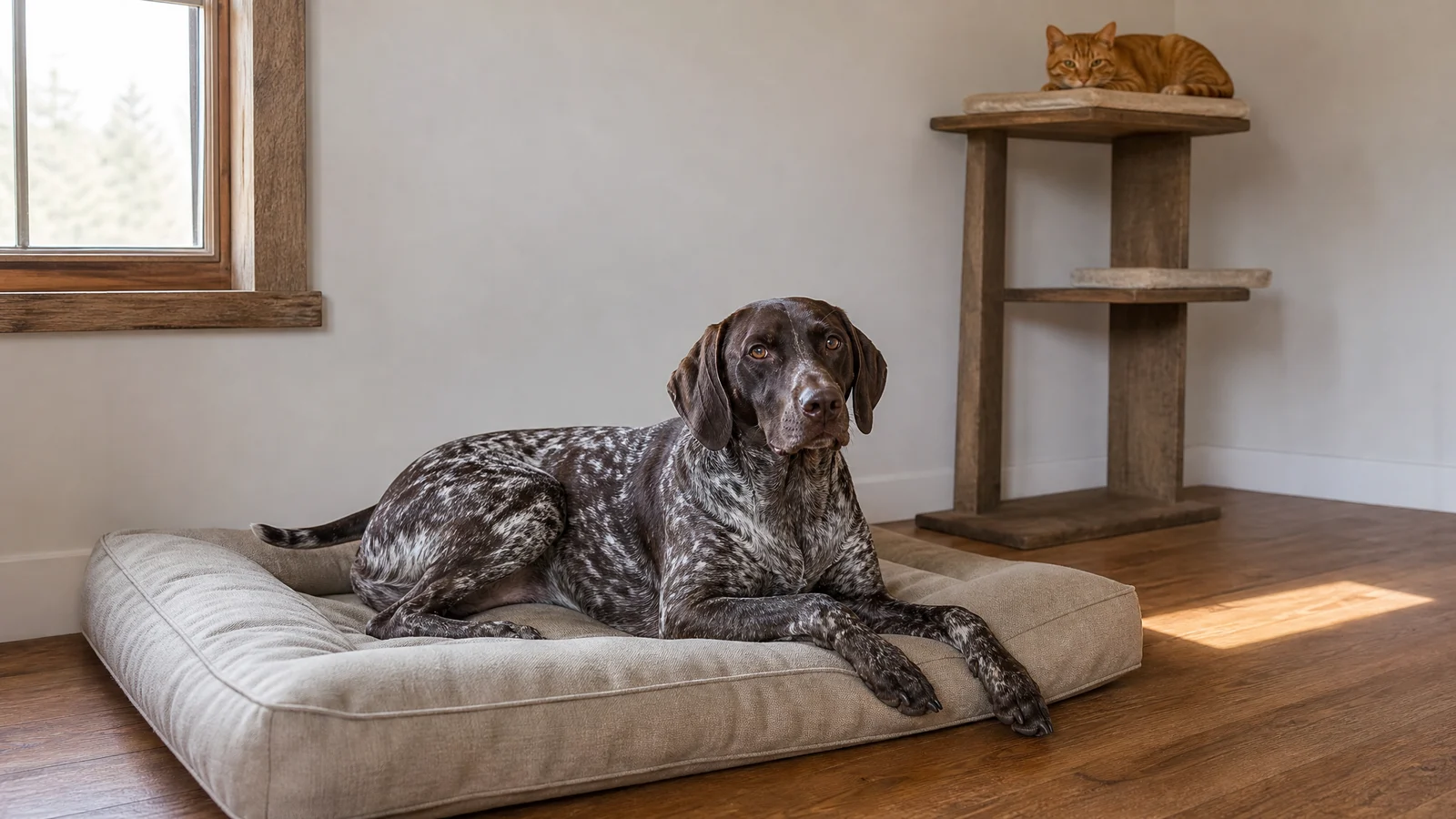
A cat and a second dog are two separate projects for a German Shorthaired Pointer household, and each one needs its own plan. A GSP who greets every newcomer with a wiggling whole body can still treat a cat's sudden dash as the best game of the day.
GSPs are sociable, smart and full of energy, a mix that tends to go well with other dogs and asks for real care around anything that runs. Cats run. Below, you'll find how to set up the house, teach your dog to stay relaxed around a cat in small stages, introduce a second dog, and decide when the animals can be left alone together.
None of it needs a perfect first meeting. It needs a slow one, in a house arranged so that nobody has to be brave on day one.
Where a GSP's Chase Drive Meets a Cat
Friendliness is the easy half of this breed. GSPs are smart, eager to please and closely bonded to their families, and those traits usually help with other dogs and, given patience, with cats. The hard half is a very high energy level paired with a strong prey drive, which means a cat who bolts across the room looks less like a housemate and more like something to chase.
That is why a breed reputation tells you so little about one GSP and one cat. Only your own dog's reactions to small, controlled steps around movement can answer that question, and the cat's own temperament matters just as much. A confident cat who stays put when something moves is an easier match for a keen GSP than a nervous one who bolts, so if you are still choosing the cat, choose for steadiness.
With other dogs the picture flips. GSPs lean sociable, but a bouncy greeting can overwhelm a quieter dog, and both animals can start a chase, so the plan for a second dog leans on leashes and neutral ground instead of closed doors.
Energy decides how much of any plan your dog can learn on a given day. A GSP who has not run, sniffed or worked for a few hours arrives at every meeting already wound up, and a wound-up dog cannot practice ignoring anything. As GSP people, we plan every meeting for the end of a walk or a run, never the start.
Setting Up a Cat's Space Before Anyone Meets
Because the cat's movement is what sets off a chase, the first job is controlling what each animal can see and reach. That work happens before anyone meets, and it starts by giving the newcomer a base of their own, whether the newcomer is a cat joining your GSP's home or a GSP joining a cat's.
During the first week, the Animal Humane Society's advice is to resist giving a newcomer the run of the house, especially when other pets already live there. A new cat is best confined to a single quiet room with their own litter box, food and a bed or box, and nobody should force an interaction.
A Checklist for Each Shared Room
Once the newcomer has settled, run through this list before the animals ever share a room. Each item removes a reason for a chase to start:
- The cat has a room or a high shelf your GSP cannot reach, with food, water and a litter box close by.
- Every barrier you plan to rely on, from a gate to a closed door, is one your GSP cannot open, push through or clear, which you can test with the cat out of sight.
- Your GSP's bed, bowls and chews stay on one side of the line and the cat's stay on the other, so nobody has to defend a favorite spot.
- Every room the cat uses has more than one way out, so no meeting ever leaves the cat cornered.
None of this is permanent decor. It is the scaffolding that lets your GSP practice being calm without ever practicing the chase, and a crate or pen can serve as your dog's own base while the cat moves around. Our notes on crate training basics cover how to make that space somewhere your GSP likes to be.
Teaching a German Shorthaired Pointer to Relax Around a Cat
With the spaces ready, training begins at a closed door instead of in the living room. The early stages are dull on purpose, because your GSP is learning that the cat's smell, sounds and shape predict treats and calm, and never a chase.
Four Stages From Closed Door to Shared Room
Work through these stages in order. Move on only when your GSP handles the current one smoothly several times in a row:
- Start with scent and sound. Swap bedding between the animals' areas and feed each of them on their own side of a closed door, so the other's smell and noises begin to predict something pleasant. Stay at this stage until the cat eats and uses the litter box as usual.
- Add sight through a barrier. Open a gate or a door a crack with your GSP on a leash, at a distance where they can notice the cat and still take a treat. Pay for every glance away from the cat, and add distance the moment a stare begins.
- Share a room with the leash on. Ask your GSP to settle on a mat as the cat wanders through at their own pace, and pay for staying put. The cat must be free to leave, because a cat who feels trapped cannot relax and a dog who is watching a trapped cat learns the wrong lesson.
- Try brief stretches together with the leash still attached. Stay close enough to step in, and end each stretch while everyone is still calm.
What to Pay For and What to Watch
The rewards carry every stage. Pay for the behavior you want to see, which is a glance away, a sniff of the floor or a settled body on the mat, and pay quickly with something your GSP loves.
A hard stare means the cat is too close or the session has run too long, because a dog locked onto a moving cat cannot take a treat or learn anything. Add distance, or finish with an easy win, and try again later in the day.
The mat does double duty. A GSP needs a job, and a settle that earns pay gives a busy mind something better to do than watch the cat. Practice your loose-leash manners away from the cat first as well, since a leash that stays slack is what keeps these meetings relaxed.
A Second Dog in a German Shorthaired Pointer's Home
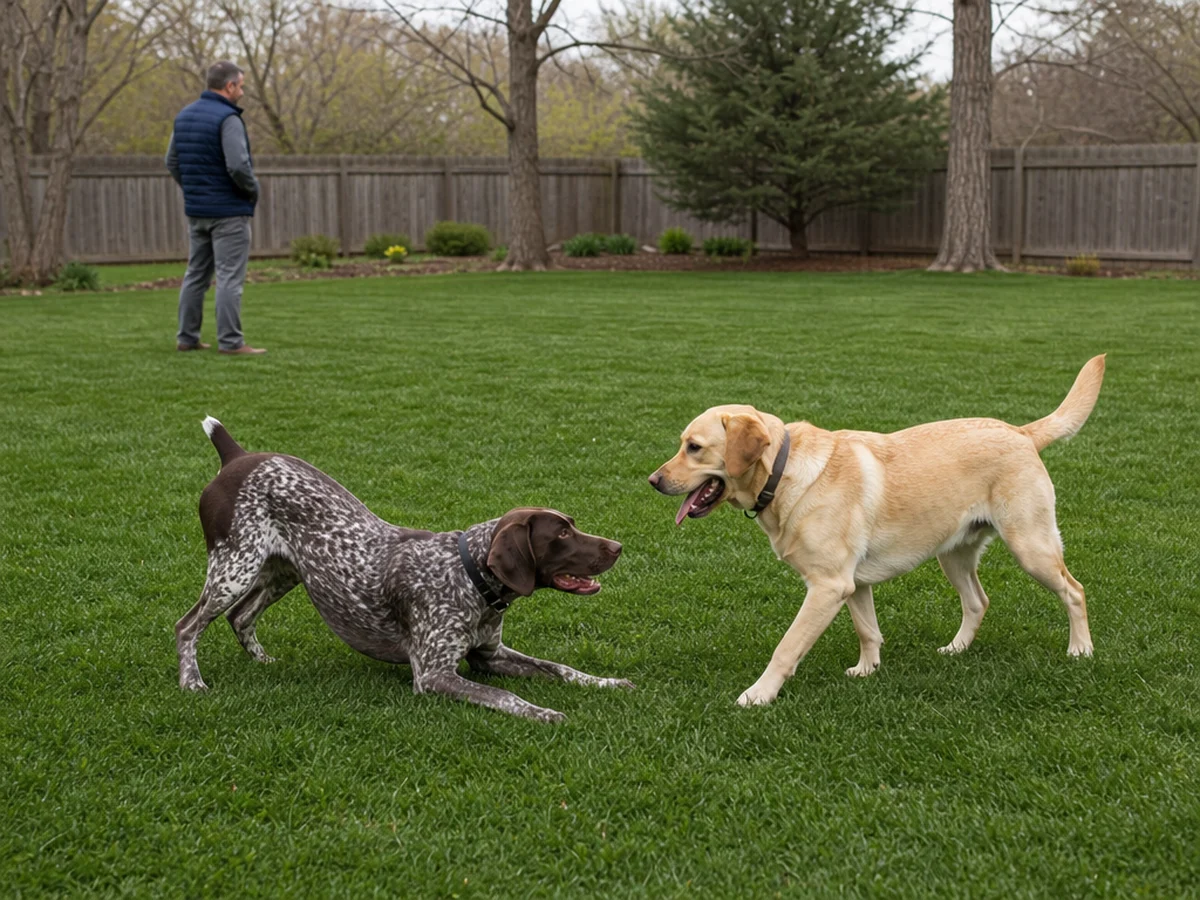
A second dog changes the question, because both animals can start a chase and either one can be chased. The plan therefore trades closed doors for leashes and neutral ground.
The First Meeting Away From Home
It is best to start on neutral territory, and the example in PDSA's guide to introducing dogs is a quiet park or large garden neither dog has visited, with both dogs on leashes held fairly loose, because dogs pick up on a tense handler, and a second person to help.
Walk the dogs side by side at a distance where both can still sniff the ground and take a treat, and close the gap only while both stay loose. Let them greet briefly, then keep walking, since moving on together is easier for both than standing nose to nose. If either dog stiffens, stares or lunges, end the meeting and try again another day from farther away.
Bringing the Dogs Home Together
After several good outings, bring the dogs to the house on leashes, resident dog first, and let them meet outside before they go in. Keep the leashes on for the first indoor meetings, and give each dog a bed, bowls and chews of their own, set well apart, with meals in different rooms so neither has anything to defend.
A GSP's bounce is the part to watch. A quick, enthusiastic greeting can be too much for a calmer housemate, so keep early sessions short and finish while both dogs are still easy. Our guide to socializing a GSP covers greetings with other dogs in more depth.
Play Rules for a Shared Home
Once the introductions work, the risk moves into ordinary life: a long rainy afternoon, a bounce across the sofa, a toy skidding past the cat. A GSP with energy to spare will find a use for it, so give your dog somewhere to spend it before shared time starts.
Daily running, play and thinking games are the base this whole page stands on, and a mentally busy GSP is a calmer housemate than one who has only been walked. A GSP who has had real running and thinking work asks far less of the cat, and of you.
Between two dogs, chase is ordinary play, and the thing to watch is whether the roles trade. Look for the chaser becoming the chased, the bigger or faster dog slowing down, and both dogs coming back for more. Play that only ever runs one direction should end calmly before it turns into pursuit.
With the cat, there are no chase games at all, not even gentle ones. A GSP learns quickly, and a game that lets them pursue the cat today makes the chase harder to resist tomorrow. We would rather you end a game a minute early than a minute late. If play with the other dog gets too wound up, a recall you have practiced well away from the other animals gives you a clean exit. Our outdoor recall games are a good place to build it.
Leaving a Cat and a GSP Alone Together
Calm meetings are not the same thing as readiness for an empty house. The gap between the two deserves its own plan, built around how long the animals stay apart and what you watch for along the way.
Many experts recommend waiting about a month before the animals have any unsupervised time, and until then they should stay safely apart whenever no one is home. Step back if a dog stays intensely fixed on the cat, lunges, snaps or ignores your attempts to redirect, or if a cat stops eating or using the litter box or hides most of the day.
A month can sound slow, but it buys weeks of calm evidence before anyone is left unwatched. A warning sign during that time does not mean the pairing has failed. It means the plan needs more distance, more time or an expert eye. Move back to an earlier stage, keep the animals apart in the meantime, and ask a qualified, reward-based behavior professional to help, especially when lunging or snapping is involved.
Mention any sudden change in either animal's mood or appetite at their regular veterinary visits, too, so that a physical cause is not mistaken for a behavior problem.
Questions From a German Shorthaired Pointer Household
A few everyday details do not belong to any single stage, yet they decide whether the plan survives a busy week. Short answers follow for four situations that a staged plan does not spell out.
Can they ever share the couch?
Some pairs do, but the couch comes last, not first. Wait until the animals have shared rooms calmly for a long stretch, keep the first couch sessions short with you right there, and let the cat choose whether to join. A cat who hops down and leaves is asking for more time, and your GSP can be paid for staying put while the cat moves.
What if the cat walks right up?
Keep the moment small. Reward your GSP for staying still or looking at you while the cat investigates, hold the leash short enough to prevent a lunge, and finish by calmly asking your dog to move away with you. A cat who approaches by choice is a good sign, as long as your GSP stays relaxed and the cat can leave whenever they want.
Who gets greeted first at the door?
Greet your GSP first, in a calm voice, before the cat is in the room, because a bouncing reunion with the cat close by is an easy moment for a chase to start. Say hello to the cat afterward in a quiet spot, so neither animal learns that the other's arrival ends their attention.
Should the dogs share toys and chews?
Not at first. Pick up toys and chews during early shared time and give each dog their own in their own spot, so nothing is worth defending. Bring items back one at a time once both dogs are relaxed together, and put them away again if either dog starts to hover.
A Household That Runs on Two Clocks
Nearly every answer above comes down to when things happen, because a cat's day runs on habit, long naps and sudden short bursts, while a GSP's day runs on long blocks of movement and play. Trouble tends to start where the two clocks collide, at a door or in a hallway, when a wound-up dog meets a cat in the middle of a dash.
So give each animal hours that are theirs. The biggest, loudest play happens in a room or yard the cat does not use, and the cat's quiet hours stay quiet, with the dog tired or busy elsewhere.
Few lessons test a GSP like a cat crossing the room, and the e-book included for readers of this site prepares you for the other tests your dog will bring, covering their training from every angle without losing you in detail.
 Puppy trainingGerman Shorthaired Pointer Puppy: First Training Steps
 Puppy trainingGerman Shorthaired Pointer at 8 to 12 Weeks: First Steps
 Puppy trainingGerman Shorthaired Pointer at 3 to 4 Months: Teething and Training
